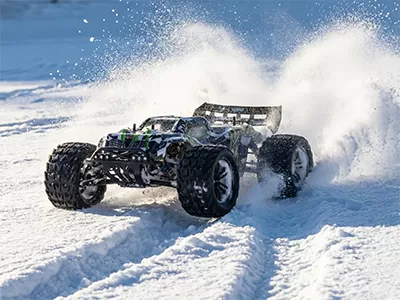
Walk through any RC pit, and you'll see them: high-mounted, aggressively angled rear wings. To the casual observer, they might look like a simple cosmetic accessory. But for the competitive racer, the rear wing is one of the most powerful and misunderstood tuning tools available.
Is it just for show? Absolutely not.
A properly configured rear wing is a critical aerodynamic device that directly translates to faster, more consistent lap times. It's the key to unlocking rear-end traction, high-speed stability, and control, both on the track and in the air. This guide breaks down the science of how your wing works and, more importantly, how to tune it for maximum performance.
The Core Principle: How Wings Generate Downforce
An RC car's rear wing functions exactly like a full-scale race car's wing, just inverted. Instead of generating lift (like an airplane wing), it's designed to generate downforce—a net downward force that pushes the car into the track surface.
This is achieved by manipulating airflow based on Bernoulli's principle:
Pressure Differential: The wing's "airfoil" shape (its curve) and its "Angle of Attack" (AOA) are designed to force air traveling over the top surface to move slower (creating a high-pressure zone).
Simultaneously, air passing underneath the wing is accelerated (creating a low-pressure zone).
This pressure difference—high pressure on top, low pressure below—is what pushes the wing, and therefore the entire rear end of the car, firmly into the ground.
The On-Track Benefits: Why Downforce = Speed
So, why is pushing the car down so important? It all comes down to traction.
1. Increased Rear Traction (Grip) This is the single most important benefit. The downforce generated by the wing physically presses the rear tires into the track surface. This "planting" effect provides more mechanical grip, allowing you to:
Apply more throttle on corner exit without the car spinning out.
Maintain control on loose, low-traction surfaces (like dust or loose dirt).
2. Unmatched High-Speed Stability Ever had your car get "squirrelly" or feel dangerously light on a long, fast straight? That's the rear end losing grip as it's buffeted by air. A rear wing provides crucial stability at high speeds, making the car feel "planted" and predictable, giving you the confidence to stay on-power longer.
3. Faster, More Confident Cornering With more downforce "gluing" the rear tires to the track, the car can carry significantly more speed through corners without breaking traction. The car will feel more balanced and responsive, especially in high-speed sweepers.
4. Off-Road: In-Air Attitude Control For off-road buggies and truggies, the wing's role extends to flight. It acts like a parachute or a rudder, allowing the driver to control the car's "attitude" during jumps.
More Wing Angle: Creates drag, helping to lift the nose (or prevent "nosing down").
Less Wing Angle: Allows the car to fly flatter or help bring the nose down if needed.
The Critical Trade-Off: Downforce vs. Drag
Nothing in racing is free. The price you pay for all that useful downforce is drag.
Drag is the aerodynamic resistance that slows your car down. A wing set for maximum downforce (a steep angle) will also create significant drag, reducing your car's top speed on the straights.
The art of tuning lies in finding the perfect balance for the track:
High-Traction Tracks (e.g., Carpet, High-Grip Clay): You may not need maximum downforce. You can reduce the wing angle to minimize drag and maximize straight-line speed.
Low-Traction Tracks (e.g., Loose Dirt, Dusty): You need all the grip you can get. A higher wing angle is crucial, even if it costs you some top-end speed.
How to Tune Your Wing: A Practical Guide
Don't just bolt on your wing and forget it. Use it as a tuning tool.
1. Angle of Attack (AOA) This is your primary adjustment. Most wing mounts offer multiple angle settings.
More Angle (Laid Back): Increases downforce and drag. Use this for more rear grip and stability on loose tracks or technical, twisty layouts.
Less Angle (Flatter): Decreases downforce and drag. Use this on high-speed, high-grip tracks to get more top-end speed.
2. Wickerbills (or Gurney Flaps) That small, 90-degree strip added to the trailing edge of the wing isn't just for looks. A wickerbill (or Gurney Flap) is a clever tuning device. It "tricks" the air, significantly increasing downforce with a very minimal penalty in drag. If your wing supports it, this is a great way to add "free" grip.
3. Wing Position (Forward vs. Rearward) The position of the wing on its mount can also fine-tune handling.
Moving Wing Forward: Shifts the aerodynamic pressure slightly forward. This can reduce rear traction a bit, helping the car rotate more in corners.
Moving Wing Rearward: Puts the pressure further back, increasing rear stability and grip, but can make the car feel less willing to turn.
4. Wing Height The height of the wing determines if it sits in "clean air" (above the turbulent air from the body) or "dirty air." Generally, a wing in clean, unobstructed air is more effective and consistent.
Your RC car's rear wing is a sophisticated aerodynamic tool. It's the key to managing rear traction, providing stability at speed, and controlling your car in the air.
Stop treating it as an afterthought. Start experimenting with angle, position, and wickerbills during your next practice day. By understanding and tuning your wing, you'll unlock a new level of performance and consistency that will leave your competition behind.