You've upgraded your motor, swapped your tires, and tuned your shocks. But if your buggy still feels inconsistent in the corners or loose under acceleration, you're likely overlooking one critical component: Differential Oil.
Tuning your differentials (diffs) is often considered a "black art," but it's actually simple physics. By changing the viscosity (thickness) of the silicone fluid inside your gear diffs, you control how power is distributed to the wheels.
Whether you are running a 1/8th scale buggy or a 1/10th short course truck, this guide will help you understand how to choose the right fluid to get your car "dialed in."
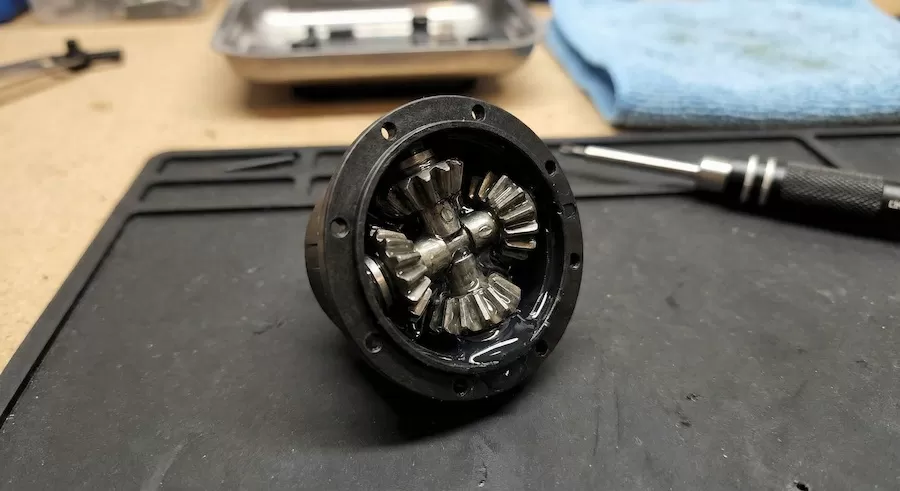
Before we dive into the specific diffs, let's talk about the fluid. RC diff oil is rated in cSt (Centistokes) or Wt (Weight).
Thinner Oil (Low cSt): Flows like water. It allows the gears inside the diff to spin freely, letting wheels rotate at different speeds easily.
Thicker Oil (High cSt): Flows like honey/molasses. It creates resistance (locking action), forcing the wheels to rotate at closer speeds.
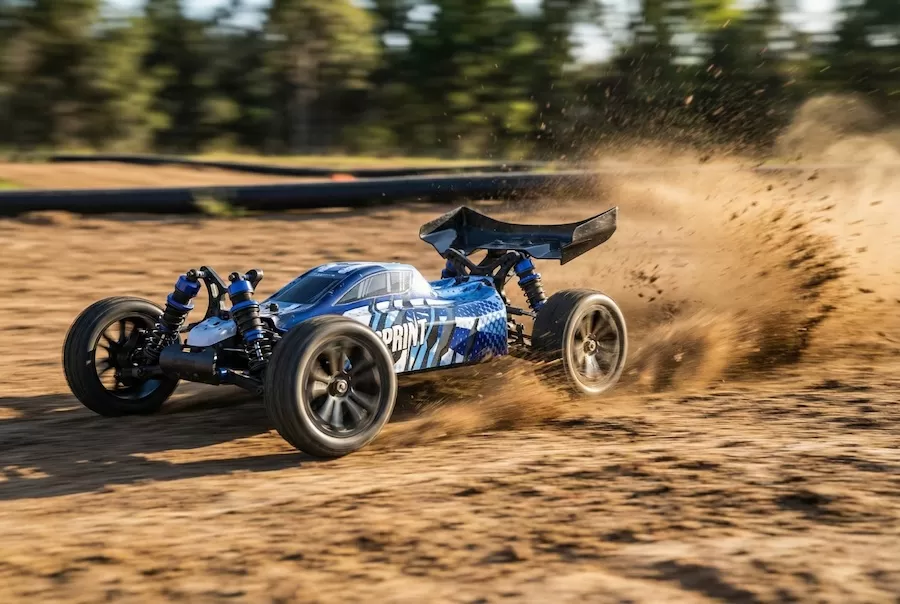
The front diff dictates how your car enters a corner and how it pulls out of it.
The Effect: Allows the front wheels to rotate independently more easily.
Pros: Increases off-power steering (turn-in). The car will feel sharp entering the corner.
Cons: You might lose forward traction during acceleration. If the oil is too thin, the inside wheel may spin uselessly (known as "diffing out"), causing inconsistent steering out of the corner.
The Effect: Locks the front wheels together more.
Pros: Increases stability under braking and provides massive on-power steering at the corner exit. It pulls the car out of the turn.
Cons: Can decrease initial turn-in steering, making the car feel "pushy" (understeer) upon entry.
Note: This applies to 4WD vehicles with a center diff (like 1/8 buggies/truggies).
The center diff manages the power split between the front and rear axles.
The Effect: Allows power to take the path of least resistance (usually to the front wheels when the rear squats).
Pros: Makes the car easier to drive on rough tracks. It settles the car down and provides more off-power steering.
Cons: Reduces acceleration punch. Warning: If you run a high-power engine/motor with oil that is too thin, the diff action becomes too violent, generating heat that can "cook" the oil.
The Effect: Forces power to be distributed more evenly between front and rear (more "All-Wheel Drive effect").
Pros: Incredible acceleration and increased on-power steering. Best suited for high-bite, smooth tracks.
Cons: The car can become nervous or twitchy. You need to be very smooth on the throttle trigger to prevent the car from getting out of shape.
The rear diff is all about rear-end traction and rotation.
The Effect: Keeps the rear planted.
Pros: Increases cornering traction and helps the car steer into the corner. Great for low-grip, loose surfaces.
Cons: Can make the car feel lazy under power.
The Effect: Encourages the rear end to break traction in a controlled manner.
Pros: Helps the car rotate (power slide) mid-corner. Reduces wheelspin, ensuring maximum forward drive.
Cons: Decreases rear traction while cornering. If it's too thick, the rear end will slide out too easily (snap oversteer).
Use this quick reference to tune your setup based on track conditions:
Track Condition | Front Diff | Center Diff | Rear Diff |
Loose / Bumpy / Low Grip | Go Thinner (Better turn-in) | Go Thinner (Soaks up bumps) | Go Thinner (More grip) |
High Grip / Smooth / Carpet | Go Thicker (Stability) | Go Thicker (Acceleration) | Go Thicker (Rotation) |
Pro Tip: Always change one thing at a time. Start with the manufacturer's stock setup (box stock) and adjust in small increments (e.g., from 5,000 cSt to 7,000 cSt).
Founded in 2008, VRX Racing (Riverhobby Tech (Shenzhen) Co., Ltd.) is a leading high-tech enterprise specializing in the R&D, manufacturing, and global distribution of radio control vehicles. Based in Shenzhen, China, VRX Racing has built a strong reputation for delivering high-performance, durable, and precisely engineered RC models for enthusiasts at every level—from beginners to professional racers.
With a comprehensive product range covering 1/5, 1/8, 1/10, and 1/18 scale RC truck, buggy, and touring car, along with a full lineup of upgrade parts and accessories, VRX Racing ensures that every driver can fine-tune their setup—just like dialing in differential oils for optimal performance. Backed by strict quality control and continuous innovation, the brand is trusted by customers across Europe, America, Australia, and beyond.
Looking to elevate your RC experience or expand your product line?
Get in touch with VRX Racing today to explore our latest models, customization options, and partnership opportunities.
Contact us now and discover how we can help you achieve precision, performance, and reliability on every track.