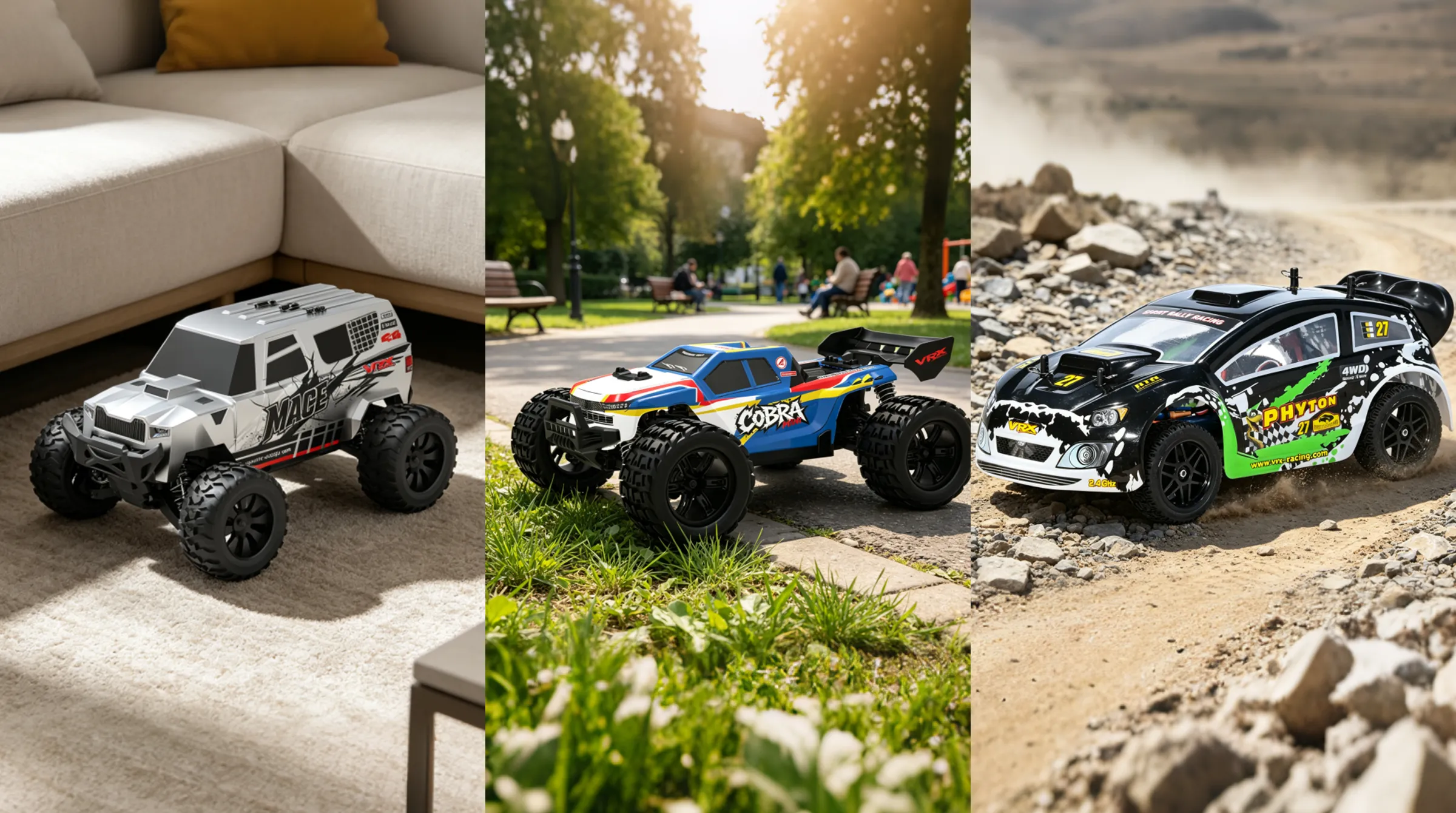
Competitive remote control (RC) racing means a lot to the enthusiasts. Local tracks, online groups, and organized events bring drivers together to share setup advice, learn from experienced racers, and improve through friendly competition. These communities help newcomers enter the sport, and make it more enjoyable for give experienced drivers to stay involved between race days.
Local tracks provide something digital platforms cannot fully replace: a place to test a car, observe different driving styles, and receive immediate feedback. Online groups extend those relationships beyond the track, helping members arrange practice, compare lap times, discuss rules, and share repair tips.
The community model suits different levels of commitment. Some racers attend weekly club meetings; others enter occasional fun races or follow larger competitions. That flexibility lets people participate without needing to compete at an elite level from the start.
Most lasting racing communities start with a local club. A regular race schedule helps, but the shared track, common rules, and people who know the practical side of the hobby are what keep it going. New drivers can learn how a race meeting runs, where to marshal, and what to prepare before qualifying.
Club racing offers a manageable first competitive step. Short heats teach race starts, traffic awareness, and consistency without the pressure of a major championship. Supportive clubs treat mistakes as part of learning rather than a reason to exclude beginners.
Established organizations then link local racing to wider competition. Before entering a formal event, drivers should check current regulations and local club requirements.
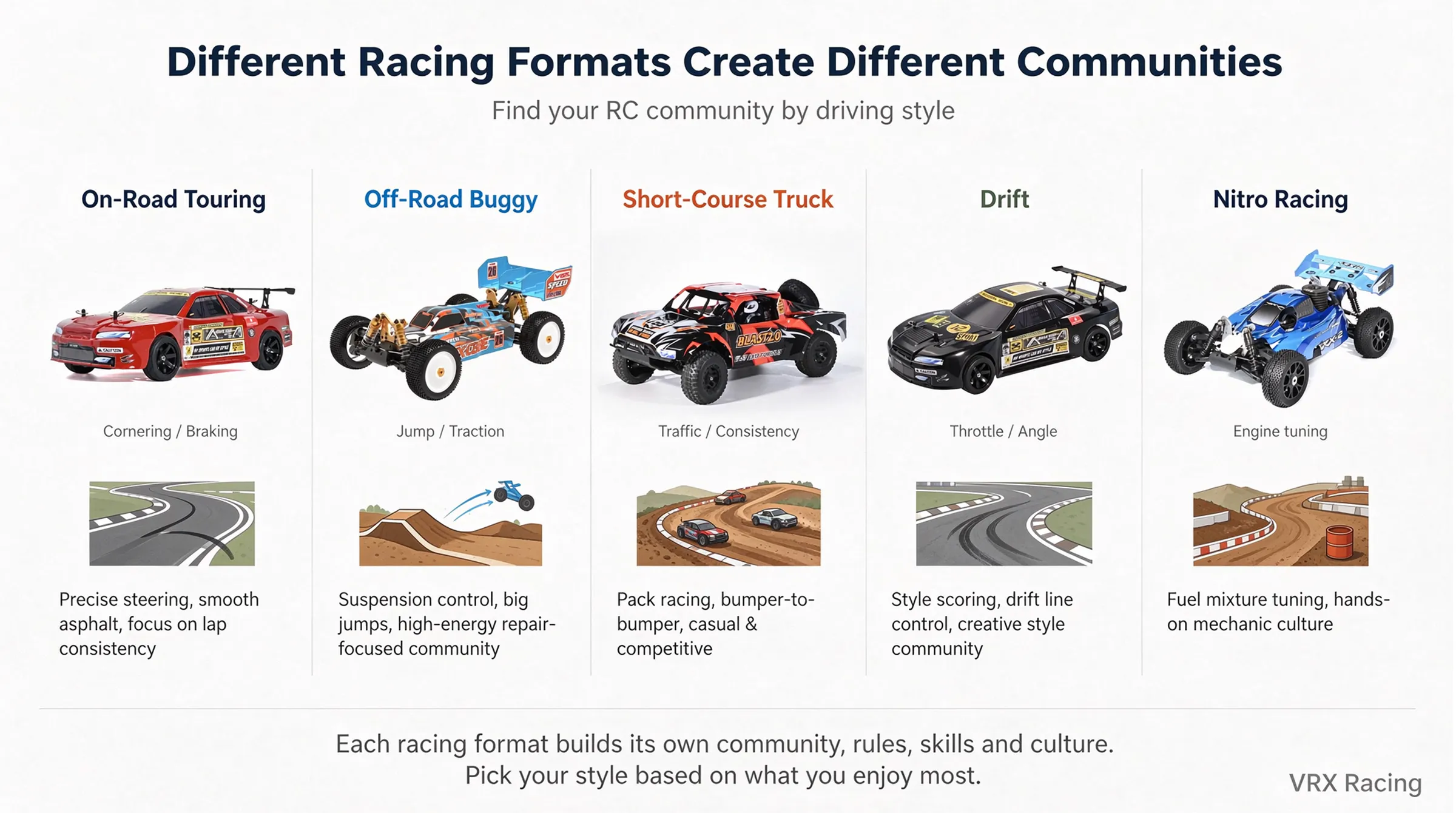
RC racing is not a single discipline. On-road touring puts a premium on smooth lines and precise braking; off-road buggy adds jumps, landings, and changing traction. Drift is judged more on angle, line, and throttle control, while short-course and oval formats bring their own race strategies. In practice, drivers often try two or three formats before settling into the one that suits them.
Format | Main skills | Community appeal |
On-road touring | Cornering, braking, smooth lines | Close racing and repeatable lap times |
Off-road buggy | Jump control, traction, landing stability | Technical driving and varied surfaces |
Short-course truck | Traffic awareness, consistency | Wheel-to-wheel racing |
Drift | Throttle balance, angle, line | Social practice and shared technique |
Nitro racing | Engine tuning, fuel management | Hands-on mechanics and pit routines |
The format also shapes what a club stocks, how a track is laid out, and how long a race day runs. A dirt layout will usually point drivers toward an electric RC buggy, while a club built around electric performance may be a better fit for a brushless electric RC car.
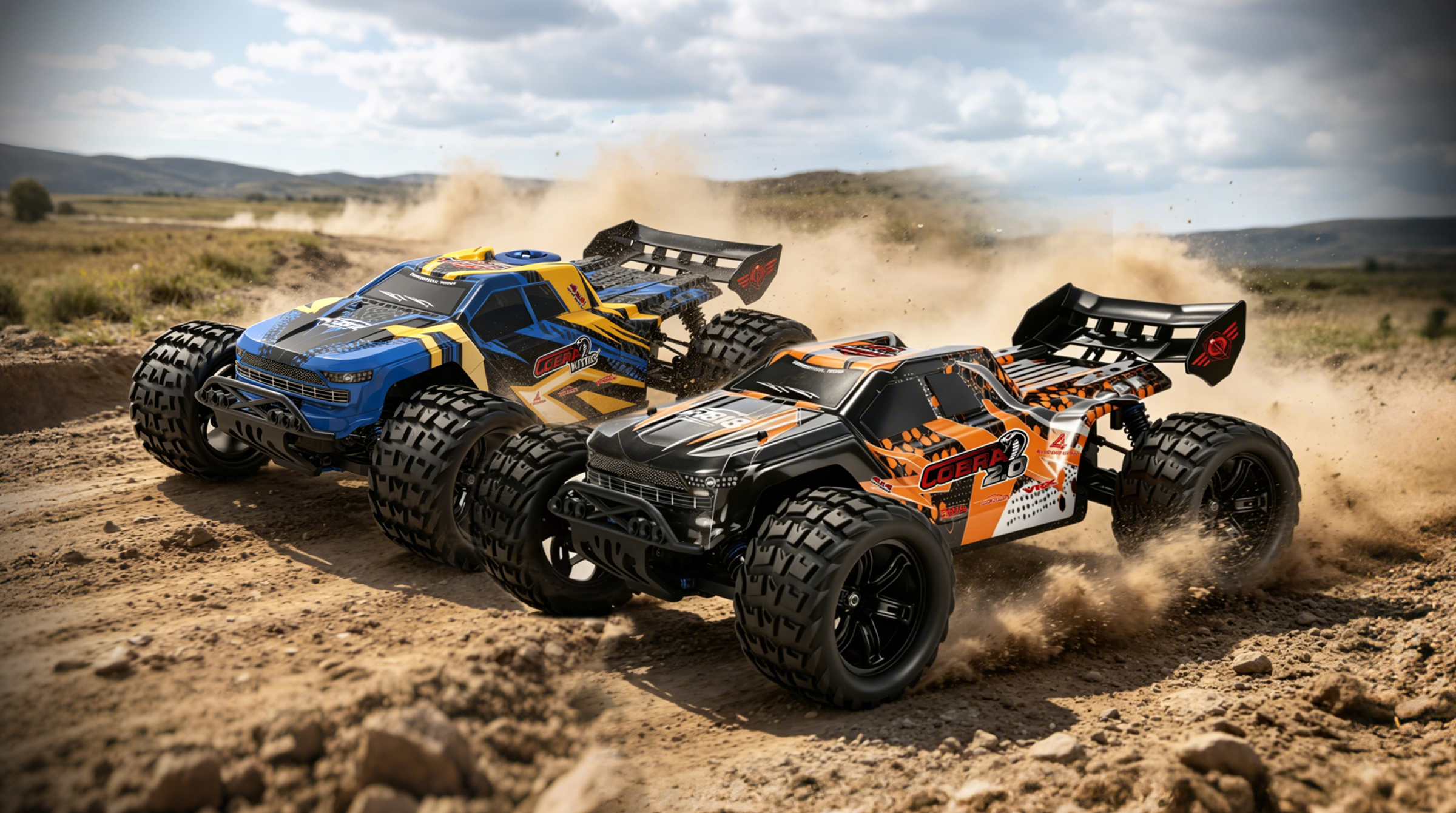
Digital groups help newcomers learn before they visit a track. Members can post practice schedules, share track conditions, trade spare parts, and ask for setup help. Short videos can show where a driver loses time, while race-management tools can share heat order and results.
The strong groups have a lot of functions. They explain basic rules, collect trusted setup resources, welcome beginner questions, and keep discussion constructive. Clear moderation helps prevent disputes and pushing members away.
Online advice should still be tested. Setup that suits one driver may not suit another. Recommendations are most useful when members exactly describe their track, tires, temperature, vehicle class, and other conditions.
RC racing requires more than steering. Batteries or fuel need to be prepared, fasteners checked, suspension adjustments understood, and mechanical problems spotted before they cost a run. A club that shares this knowledge turns a steep learning curve into a set of manageable routines.
Experienced racers can show newcomers how they set ride height, what they check on worn parts, how they choose tires, and why they keep a pre-race checklist. Explaining those steps out loud also helps experienced members see what they have stopped questioning. That exchange builds confidence and makes technical knowledge feel less intimidating.
Clubs can support this by pairing newcomers with volunteers and running open practice before points events. A short transmitter and marshaling briefing also helps, as does a basic checklist covering battery safety, failsafe operation, radio checks, and vehicle inspection.
Rules only build trust if drivers know what they are and see them applied the same way to everyone. Class rules typically cover dimensions, motor limits, battery requirements, tires, and permitted modifications. Race procedures need to be just as clear about qualifying, starts, track access, marshaling, penalties, and protests.
Rules make results more meaningful. When drivers understand what is allowed and everyone follows the same process, performance depends more on preparation and skill than on misunderstandings. Organizers should publish the relevant rules in advance and explain local variations clearly.
Technical inspection should fit the event. A casual club night may only need basic safety and class checks. A championship will usually require something more detailed. What matters is that the same checks are applied consistently—not that every event uses the most complicated process.
Registration should make the practical details clear before anyone arrives: entry fees, which class their vehicle fits, required equipment, track rules, and whether a car can be borrowed or rented. Newcomers also need to know where to stand, when to marshal, and who to ask when something is unclear.
Clubs do not have to wait until people own a full race setup. Beginner heats, mixed-skill practice, family days, and demonstrations give them a chance to try the sport first. It also helps to check that viewing areas are accessible, noise is managed reasonably, and race schedules do not exclude people with different ages or responsibilities.
A welcoming culture does not mean removing standards. Drivers still need to follow safety rules, respect marshals, and use vehicles responsibly. Clear expectations help beginners and experienced racers share the venue.
Grassroots racing relies on people who do more than drive. Track preparation, timing, race control, equipment maintenance, communications, and cleanup all take time.
A practical club plan can distribute the workload:
l Rotate marshaling and track duties where the format allows it.
l Publish a calendar early so members can plan attendance and volunteer shifts.
l Match race formats to staff availability and track capacity.
l Share results, schedules, and rule updates through one reliable channel.
l Keep common tools or spare parts available where possible.
A short briefing, clear timetable, and prompt results post make race days easier to follow. Recognizing volunteers reinforces that the club is a shared project rather than a service delivered by a few people.
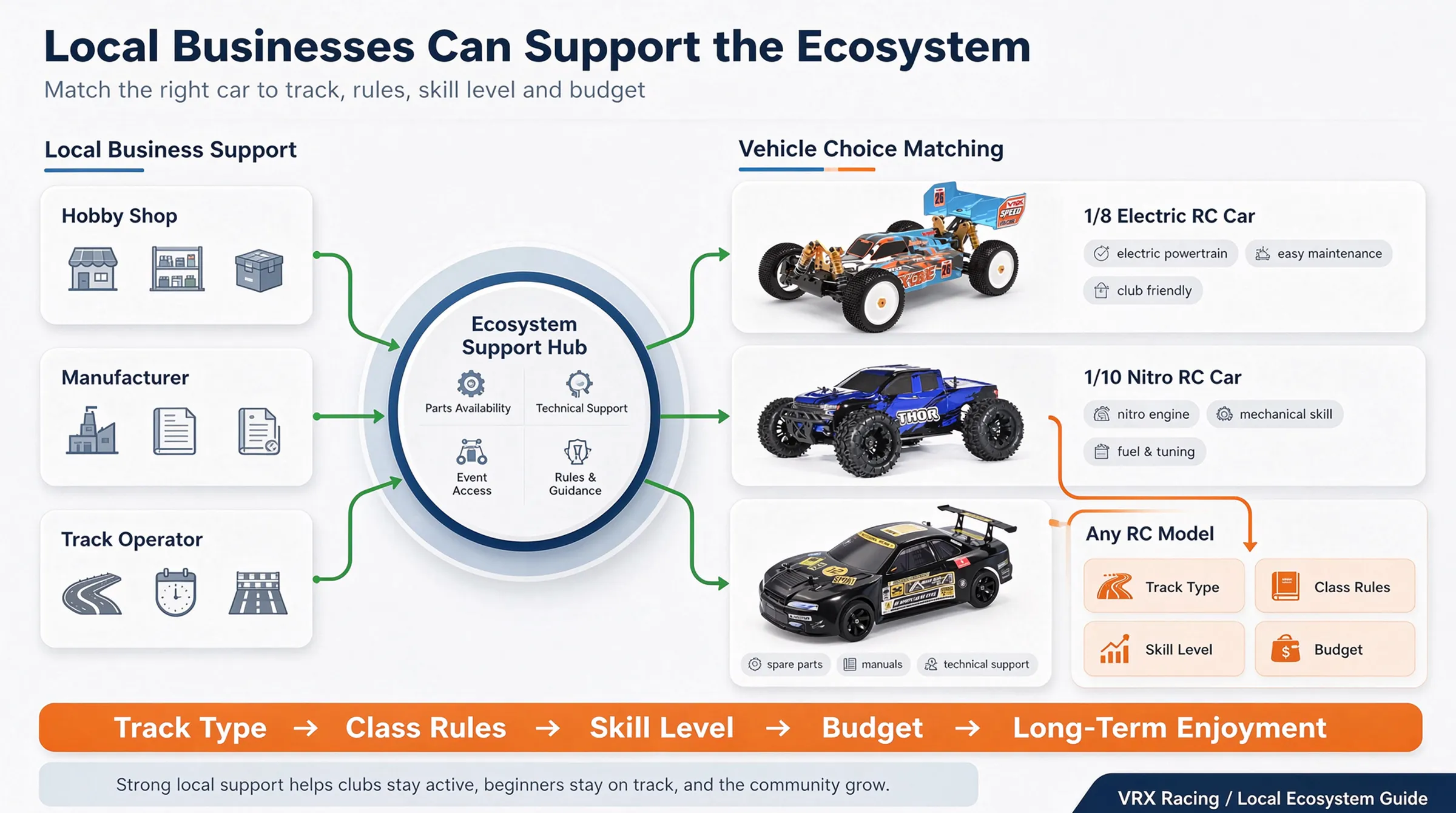
Hobby shops, manufacturers, and track operators help by stocking common spare parts, recommending suitable classes, and supporting beginner events.
A vehicle should fit the track, class rules, repair skills, and budget. For clubs with larger off-road layouts, 1/8 scale electric RC cars may suit the venue. A 1/10 nitro RC car may appeal to drivers who enjoy engine tuning. Spare-parts availability and technical support should be part of the decision.
Brands can contribute with clear manuals, consistent specifications, and reliable replacement parts. Drivers are more likely to stay active when routine repairs are manageable. Current vehicle platforms are available from VRX racing.
As a club grows, the pressure usually lands on the same areas: track time, volunteers, and money. Facility rental, track maintenance, timing equipment, insurance, and event costs all determine how often a club can race—not how often its members would like to.
Cost can also push competition in the wrong direction. If entry-level classes turn into upgrade contests, beginners may decide the sport is not for them. Spec classes, motor limits, and budget-focused categories can keep the emphasis on driving skill while still leaving room for open classes.
Online groups have a different problem. Misinformation and conflict are common, and both can erode trust quickly. Moderation helps, but so does a culture where members disagree respectfully and support advice with evidence. The aim is to keep technical debate useful and welcoming, not to let it become personal or misleading.
Better timing systems, live results, onboard video, and shared telemetry can make race days more engaging. Drivers may review their lines after a heat, compare lap consistency, or discuss a setup using recorded data. These tools are most useful when they support learning without making expensive technology a condition of participation.
Hybrid communities will likely remain valuable: online channels organize events, while the track provides driving practice and social connection. Simulators and remote-control demonstrations can introduce newcomers to racing concepts, but they work best as entry points rather than replacements for shared track time.
Technology can make racing easier to manage; people make it worth returning to. Regular practice, fair competition, mentoring, and a welcoming first experience help communities stay active and attract new drivers.