As manufacturers, we at VRX Racing live and breathe this stuff. Getting your gearing right is the key to unlocking your car's true potential. It's the ultimate trade-off: are you chasing blistering top-end speed or neck-snapping low-end punch?
This guide will break down everything you need to know to stop guessing and start tuning.
Before we touch a single gear, let's clear up the single most confusing part of gearing terminology. In the RC world, the terms "high" and "low" are often used in a way that seems backward to the numbers.
Here are the key points to remember, based exactly on your notes:
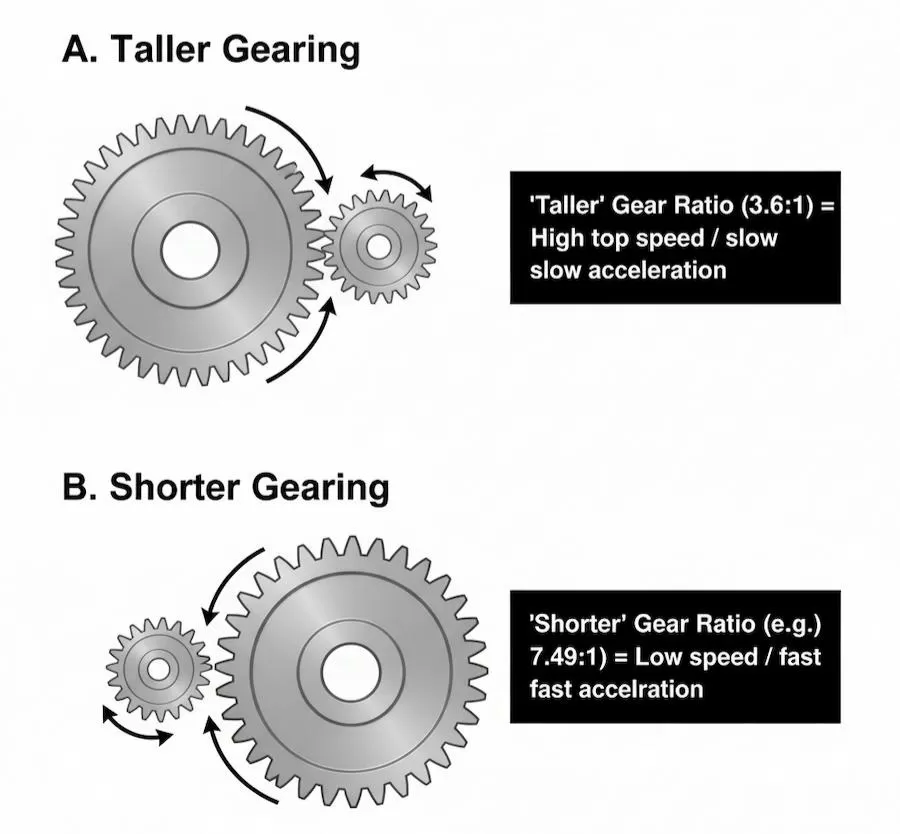
A Lower Numbered Ratio (e.g., 3.6:1) is called "Taller" Gearing.
Result: Higher Top Speed, Slower Acceleration (less "punch").
Why? Because the wheels turn at a higher rate (more rotations) for every single rotation of the motor.
Think: Less chance of wheelies, built for long straights.
A Higher Numbered Ratio (e.g., 7.49:1) is called "Shorter" Gearing.
Result: Quicker Acceleration (more "punch"), Lower Top Speed.
Why? Because the wheels turn at a lower rate (fewer rotations) for every single rotation of the motor.
Think: More chance of wheelies, built for instant power and "jumping off the line."
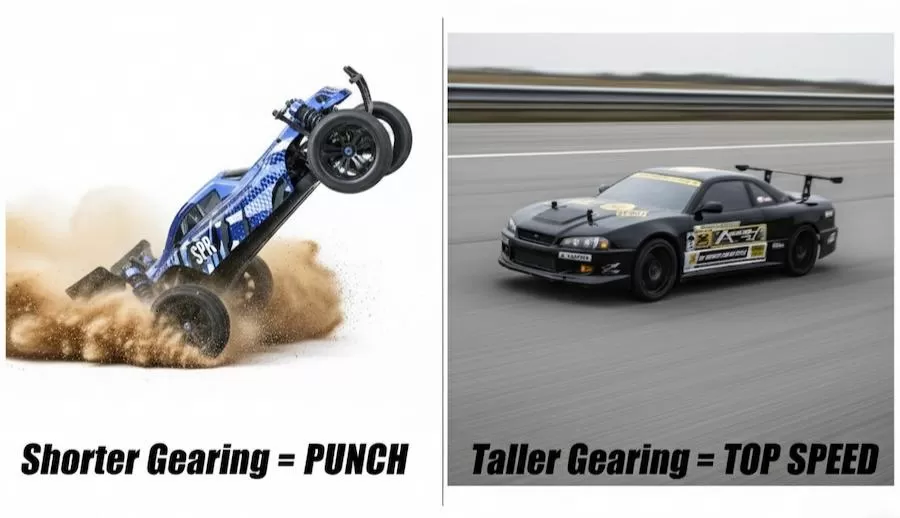
When you gear "taller" (using a smaller numerical ratio), you are prioritizing top-end speed. You achieve this by either:
Using a larger pinion gear.
Using a smaller spur gear.
This is your setup for "speed runs" or long, open tracks where you can really open up the throttle.
The Trade-Off: You will sacrifice that instant "punch." Your car won't accelerate as hard from a dead stop, and it will feel less responsive at low speeds.
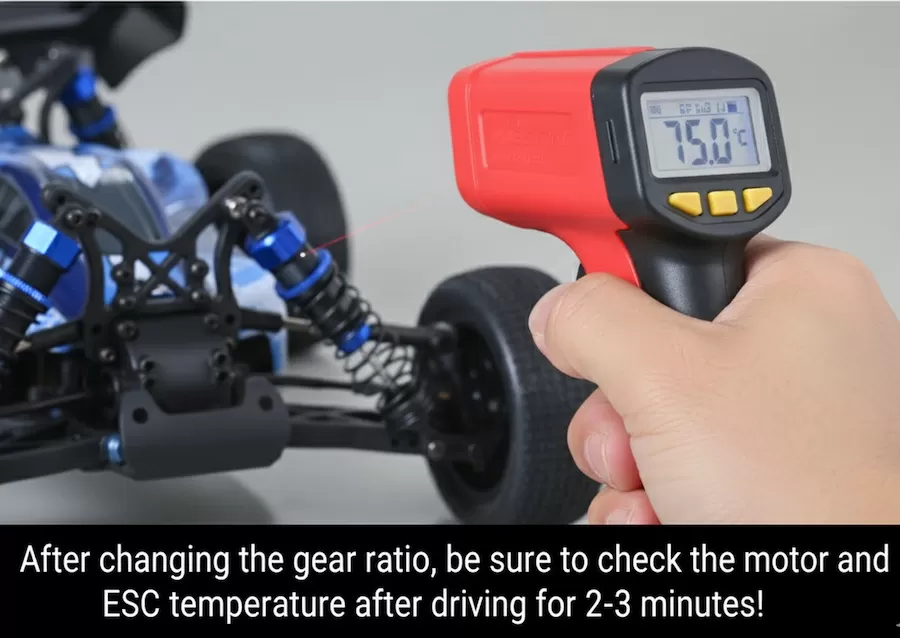
Pro-Tip (The Heat Warning): Taller gearing (a larger pinion) puts a massive load on your motor and ESC. This is the fastest way to overheat and "cook" your electronics. Always use a temp gun after a 2-3 minute run. If your motor is too hot to comfortably touch (generally over 160-170°F or 70-75°C), your gearing is too aggressive (too "tall").
When you gear "shorter" (using a larger numerical ratio), you are prioritizing acceleration and torque. You achieve this by either:
Using a smaller pinion gear.
Using a larger spur gear.
This is the setup you want for "pulling wheelies on command," "jumping off the line," or running on tight, technical tracks (like short-course) where you are constantly on and off the throttle.
The Trade-Off: You will sacrifice your top-end speed. Your car will "top out" or "rev out" very quickly on a long straight, and other cars may pull away.
Pro-Tip (The Rev-Out): While this is generally safer for your electronics, if you gear too short, you can over-rev your motor, which also generates unnecessary heat and wear.
Stop guessing. Start calculating. Here's how.
1. Basic Gear Ratio (For simple/older models)
This is the most basic calculation, looking only at the two main gears.
Formula: Number of Teeth on Spur Gear / Number of Teeth on Pinion Gear
Example (from your notes): Let's say you have a Traxxas Revo with a 72-tooth (72T) spur gear and a 20-tooth (20T) pinion gear.
Calculation: $72 \div 20 = 3.6$
Result: Your basic gear ratio is 3.6:1.
2. The Real Number: Final Drive Ratio (FDR)
This is the number that really matters for tuning. The Final Drive Ratio (FDR) accounts for your car's internal transmission ratio. Almost all modern hobby-grade cars have an internal ratio set by the gearbox. You can find this number in your car's manual.
Formula: (Spur Teeth / Pinion Teeth) x Internal Gear Ratio = FDR
Example (from your notes): You have an HPI RS4 MT with a 72T spur and a 25T pinion. You check the manual, and the HPI RS4 MT has an internal gear ratio of 2.6.
Calculation: $(72 \div 25) \times 2.6 = 2.88 \times 2.6 = 7.488$
Result: Your Final Drive Ratio (FDR) is 7.49:1.
What does 7.49:1 mean? It means the motor has to turn 7.49 times for the tire to make one complete rotation. This number is what you compare with other racers when "talking setup."
As a leading RC car manufacturer, VRX Racing (Riverhobby Tech Shenzhen Co., Ltd.) has been driving innovation in the RC model industry since 2008.
Based in Shenzhen, China, we are a high-tech enterprise integrating R&D, production, and global sales, dedicated to delivering high-performance RC vehicles for enthusiasts of all levels.
From 1/18 to 1/5 scale trucks, buggies, and touring cars, our product lineup is engineered with precision and backed by strict quality control standards to ensure reliability, durability, and an exceptional driving experience. Trusted by customers across Europe, America, and Australia, VRX Racing continues to push the boundaries of performance while putting customer needs at the core of everything we do.
Looking to partner with a reliable RC car manufacturer or upgrade your RC lineup?
Contact VRX Racing today to explore our full product range, customization options, and global distribution opportunities—let’s build something fast together.
Gearing is a balancing act, and there is no single "perfect" gear ratio.
A Temp Gun is Your Best Friend: We said it before, and we'll say it again. Do not tune without one. Heat is the #1 killer of electronics.
Tune in Small Increments: Don't jump from a 20T pinion to a 25T. Go up or down 1-2 teeth at a time, run the car, check temps, and feel the difference.
Listen to Your Rig: A properly geared car sounds "happy." It accelerates smoothly and efficiently. If you hear the motor "straining" (bogging) or "screaming" (over-revving), your gearing is likely off.