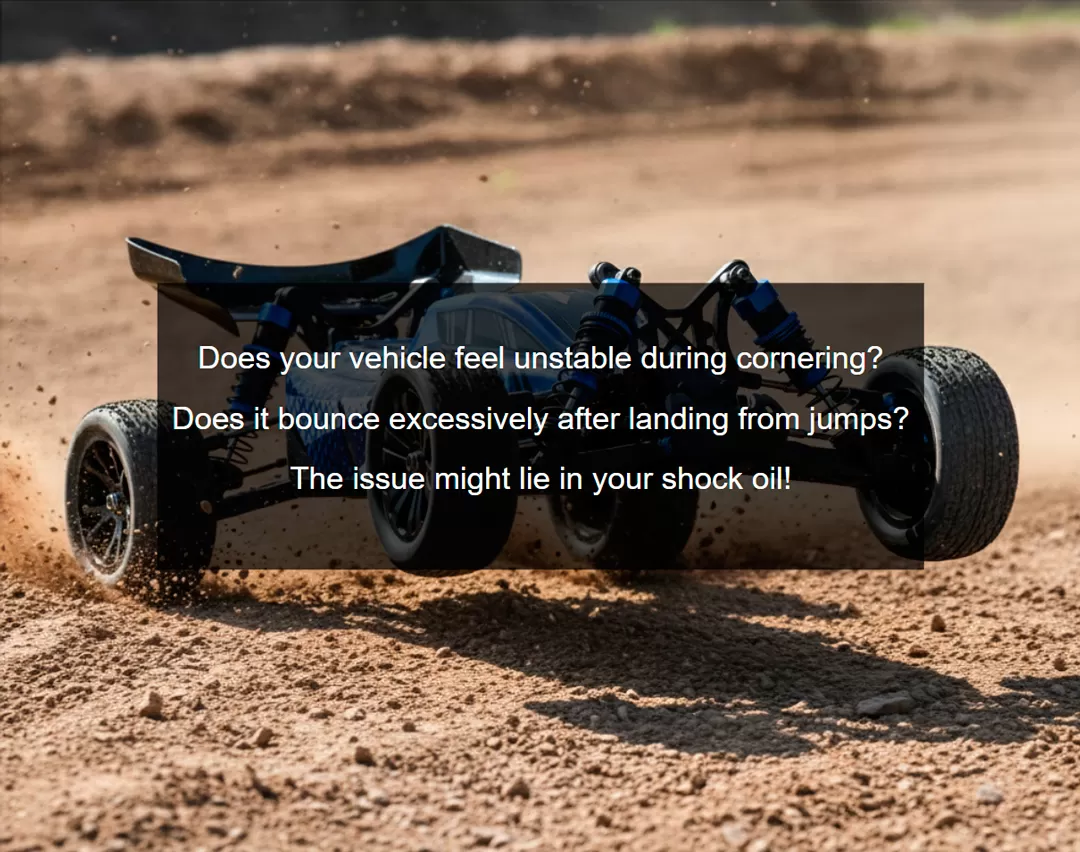
In the world of RC modeling, the suspension system is the critical link between your vehicle and the track surface, and shock oil serves as the "soul" of this system. Whether you're a beginner or an experienced driver seeking performance gains, mastering shock oil can significantly transform your driving experience.
Shock oil fundamentally determines the compression and rebound speed of the damper, thereby controlling the "damping" characteristics of the suspension. Imagine if your dampers rebounded freely like springs—the vehicle would oscillate uncontrollably after every bump. Shock oil provides controlled resistance, ensuring the wheels maintain optimal contact with the surface for maximum traction.
Distinct Roles of Front and Rear Dampers:
The primary function of front dampers is to control steering response and front-end stability.
Oil too thick (high viscosity): Steering becomes more direct, but grip is reduced.
Oil too thin (low viscosity): Steering feels smoother, and front tire grip improves.
The primary function of rear dampers is to manage rear traction and corner-exit stability.
Oil too thick (high viscosity): Reduces body roll and increases stability.
Oil too thin (low viscosity): Improves grip but results in slower response.
Front dampers act as the vehicle's "steering wheel," directly influencing turn-in response. Excessively thick oil can cause understeer (pushing), while overly thin oil may make the front end too nervous, leading to oversteer.
Rear dampers manage power delivery. Oil that is too thick can cause the rear wheels to skip over bumps, losing traction, while oil that is too thin leads to excessive body roll, compromising stability on corner exit.
Shock oil is typically measured in cSt (centistokes) or WT (Weight). These units are roughly convertible (e.g., 400cSt ≈ 35WT, with slight variations between brands).
Here are common baseline setups for 1/8 and 1/10 4WD buggies:
 |  |  |  |
Smooth Carpet / Turf Track: Front: 500 cSt (40 WT) Rear: 450 cSt (35 WT) | Hard-Packed Dirt: Front: 450 cSt (35 WT) Rear: 400 cSt (30 WT) | Loose / Bumpy Dirt: Front: 400 cSt (30 WT) Rear: 350 cSt (27.5 WT | Tracks with Numerous Jump Sections: Front: 600 cSt (45 WT) Rear: 500 cSt (40 WT) |
Pro Tip: Adjust in increments of approximately ±50 cSt to observe noticeable differences. When fine-tuning, change only one variable at a time to accurately assess its impact.
Suspension performance is a holistic system. Merely changing the oil is insufficient. Consider the following interdependent factors:
Piston Hole Size: Larger or more holes result faster oil flow, often necessitating thicker oil.
Spring Rate: Stiffer springs generally require thicker oil to control rebound effectively.
Ambient Temperature: Cold temperatures thicken the oil, heat thins it—adjust oil weight according to conditions.
Golden Rule: Stiff springs typically pair with thick oil; soft springs with thin oil. Large piston holes often require thick oil; small holes require thin oil.
4.1. Filling Techniques: Details Make the Difference
Bleeding: After filling, gently cycle the shock shaft to allow air bubbles to escape. Repeat until no bubbles remain.
Consistency: Ensure all four dampers have identical oil volume and travel for balanced handling.
Oil Volume: Typically, leave a 2–3mm air gap; do not fill completely.
4.2.Rebound Test: A Simple Diagnostic Method
Compress the shock shaft to halfway, release, and observe:
Rebound too fast (under ~0.5 seconds): Oil is too thin.
Rebound too slow or sticky (over ~2 seconds): Oil is too thick.
Smooth rebound in about 1 second: Damping is well-balanced.
4.3. On-Track Validation: The Ultimate Test
Bottoming out on landings: Increase oil viscosity or use stiffer springs.
Excessive bouncing on landings: Increase oil viscosity.
Harsh ride, chassis kicking on jumps: Use thinner oil.
Understeer (pushing) in corners: Thinner front oil / thicker rear oil.
Oversteer (loose) in corners: Thicker front oil / thinner rear oil.
Front Dampers: 500 cSt (40 WT), 1.3mm × 8-hole piston, medium-hard springs.
Rear Dampers: 400 cSt (30 WT), 1.2mm × 8-hole piston, soft springs.
Ride Height: Lower arms slightly below horizontal.
Rebound Setting: 30–40%.
This setup is well-suited for medium-traction, technical off-road tracks with jumps, offering an excellent balance between steering response and corner-exit stability. It serves as an ideal baseline for further tuning.
Suspension tuning is one of the most refined arts in RC, demanding patience and accumulated experience. Remember: There is no universal perfect setup—only the setup that works best for you and your specific track conditions.
Start with the recommendations provided here, then fine-tune based on your driving style and track characteristics, gradually building your personal "setup library."
The track is the ultimate teacher, and your feel for the car is the final judge. Now, prepare your shock tools and start tuning!