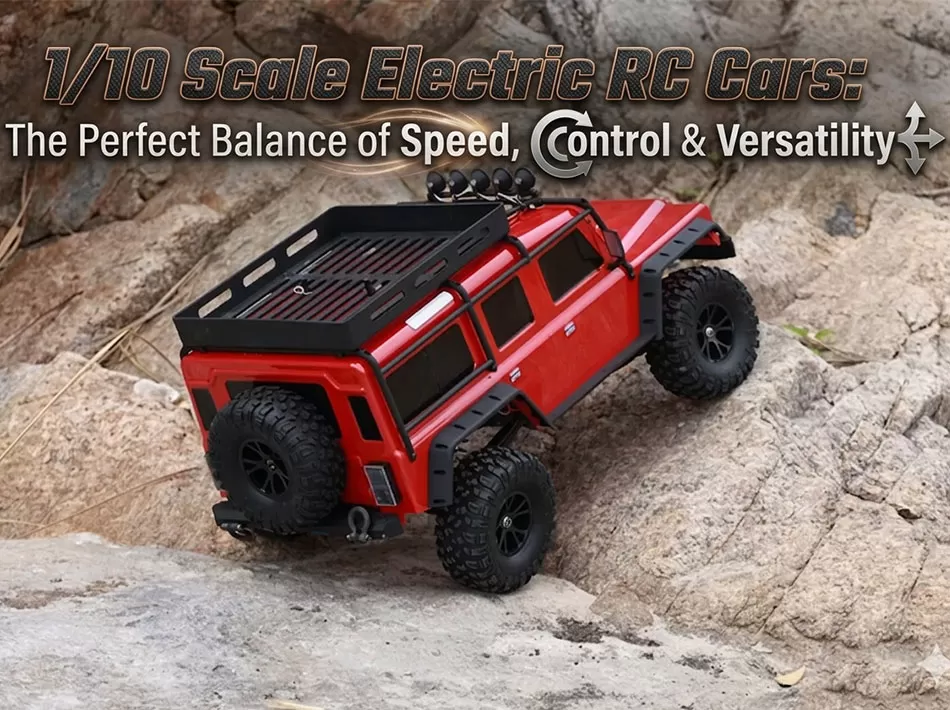
An RC crawler is not a fast car. It is a slow, deliberate machine built to do something far harder: maintain traction on surfaces that would stop almost any other vehicle. Rocks, roots, loose shale, steep sidehills, mud bogs—these are the conditions crawlers are designed to survive, and every engineering decision in the vehicle serves that single goal. This article breaks down the systems that make crawlers capable on extreme terrain.
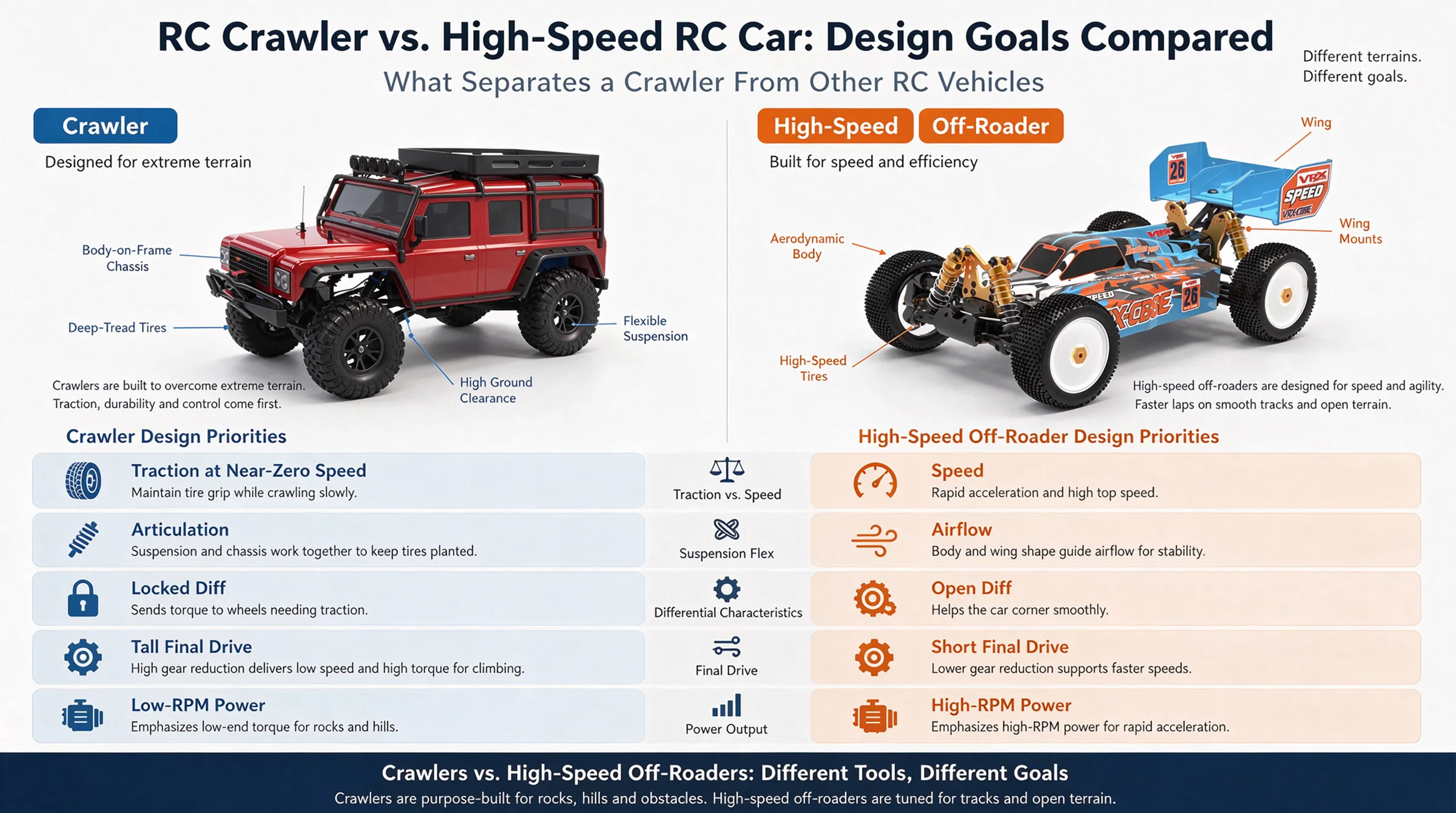
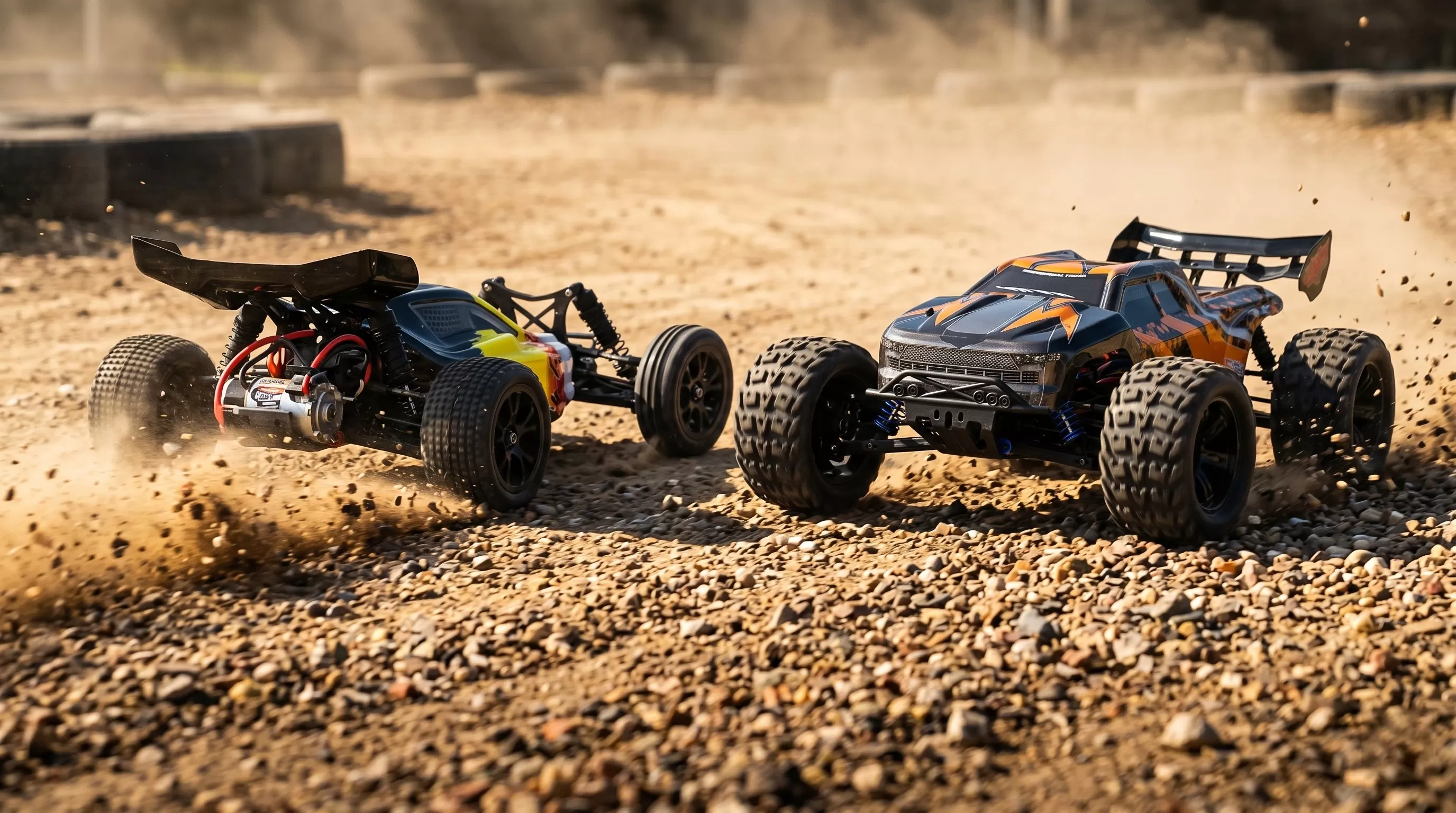
A high-speed buggy optimizes for airflow, suspension travel, and power delivery at wide throttle openings. A crawler optimizes for something entirely different: holding traction at near-zero speed.
That difference shapes the entire vehicle. Crawlers run high-turn brushed or low-KV brushless motors. They use locked differentials instead of open diffs. Their suspensions are designed for maximum articulation rather than flat cornering.
The single most important drivetrain decision in a crawler is differential behavior.
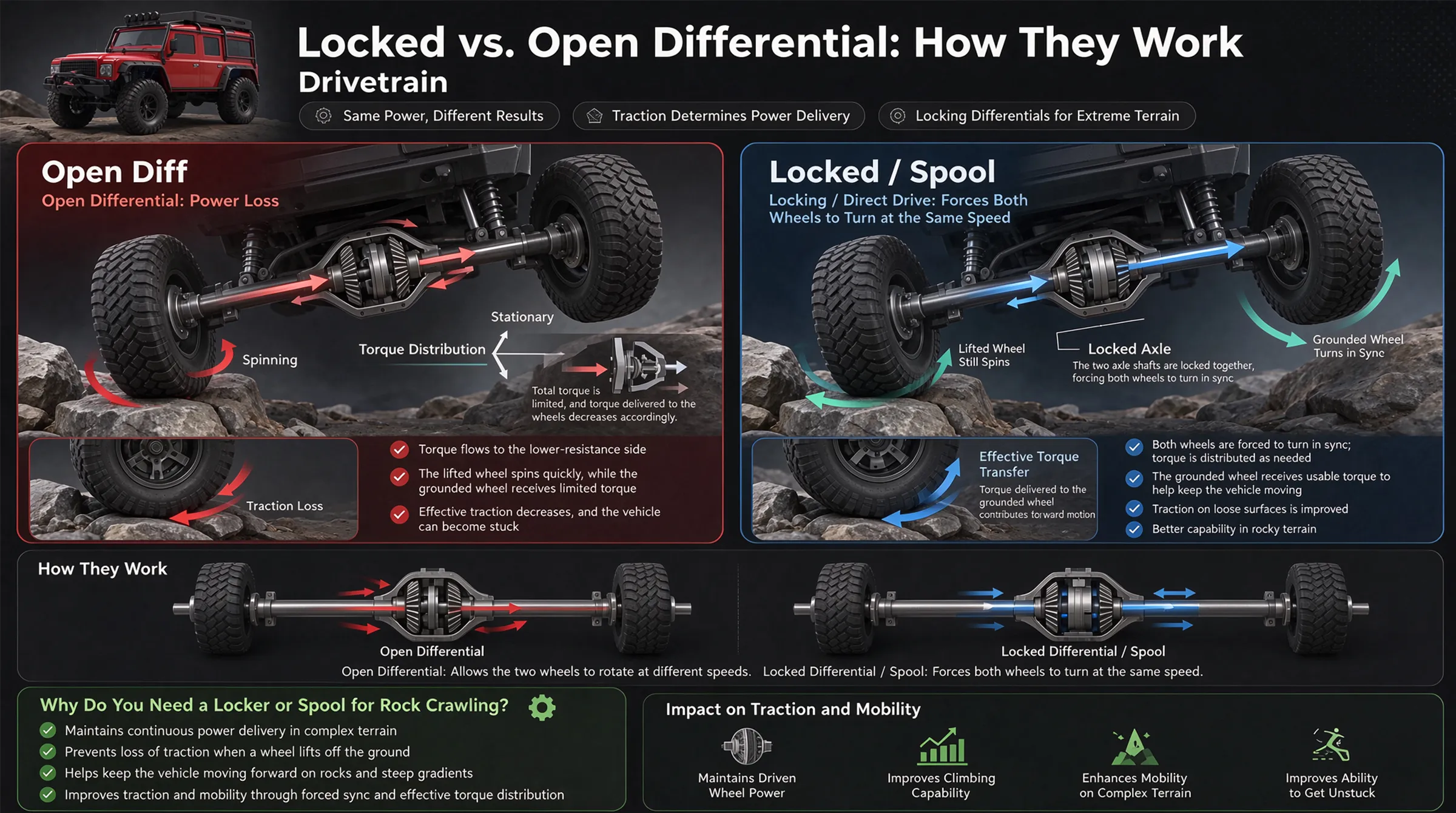
An open differential sends power to the wheel with the least resistance. That works on pavement. On a rock face, it is a disaster. If one tire lifts off the ground, the open diff spins it freely while the grounded tire receives almost no torque. The vehicle stops.
Crawlers solve this with locked or spool differentials. A spool physically locks the left and right axle shafts together, forcing both wheels to rotate at the same speed regardless of traction. VRX Racing’s BJ-4J (RH1055) crawler uses a straight-axle spool design for exactly this reason: maximum traction, minimal complexity.
Some high-end crawlers use selectable lockers, which let the driver switch between open and locked modes from the transmitter. This adds mechanical complexity but offers flexibility on mixed terrain.
Gear reduction is equally critical. A crawler’s final drive ratio is deliberately tall—often in the range of 40:1 to 100:1—to convert motor RPM into usable torque at the wheels. Lower ratios mean slower wheel speed and greater control on technical lines.
Drivetrain Element | Crawler Design | High-Speed RC Car Design |
Differential | Locked / spool | Open or limited-slip |
Final drive ratio | Very tall (40:1+) | Short (5:1–12:1) |
Motor type | High-turn brushed or low-KV brushless | Low-turn brushed or high-KV brushless |
Throttle character | Linear, low-speed precision | Aggressive, high-RPM power |
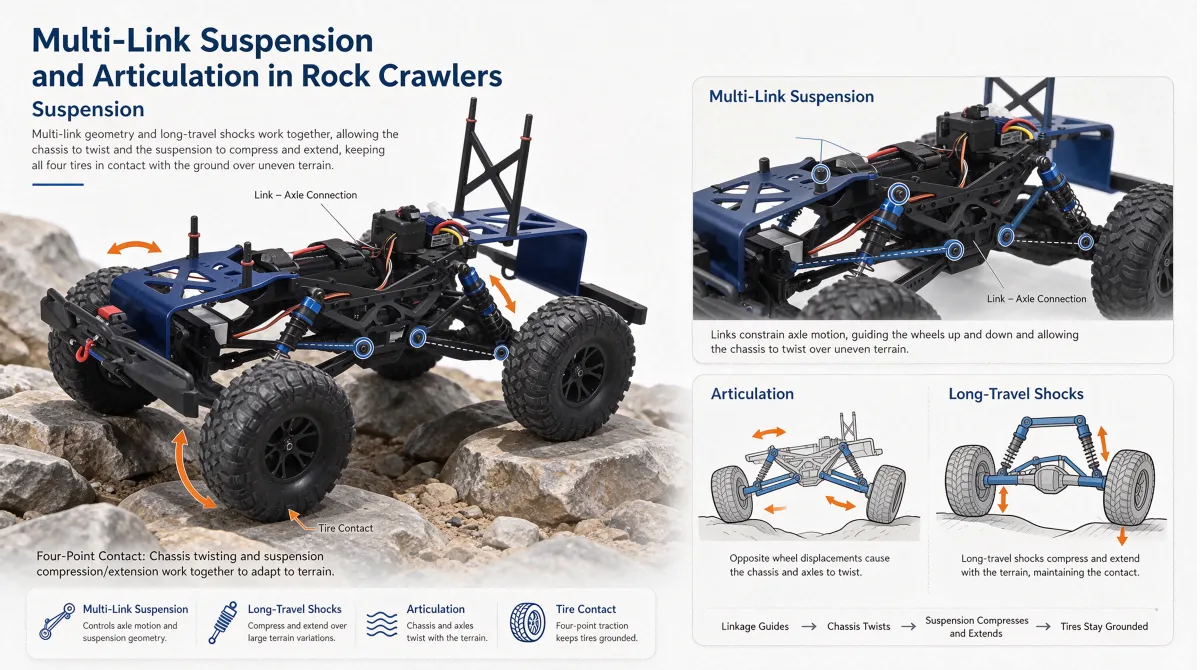
A crawler with stiff suspension will lift a tire on uneven ground. A crawler with properly tuned suspension will keep all four tires planted, even when the chassis is twisted at an extreme angle. This is called articulation, and it is the defining characteristic of crawler suspension design.
The geometry is adjustable for a reason. Moving the upper link mounting points changes how the suspension behaves under torque. Raising the front links can reduce front-end lift under power; lowering the rear links can change how the rear axle reacts to weight transfer. Serious crawler builders tune these angles for specific terrain types.
VRX Racing’s electric rock crawlers use multi-link suspension paired with long-travel aluminum shocks. The design allows the axles to twist and articulate dramatically, keeping the tires in contact with uneven rock surfaces even when the chassis is heavily tilted.
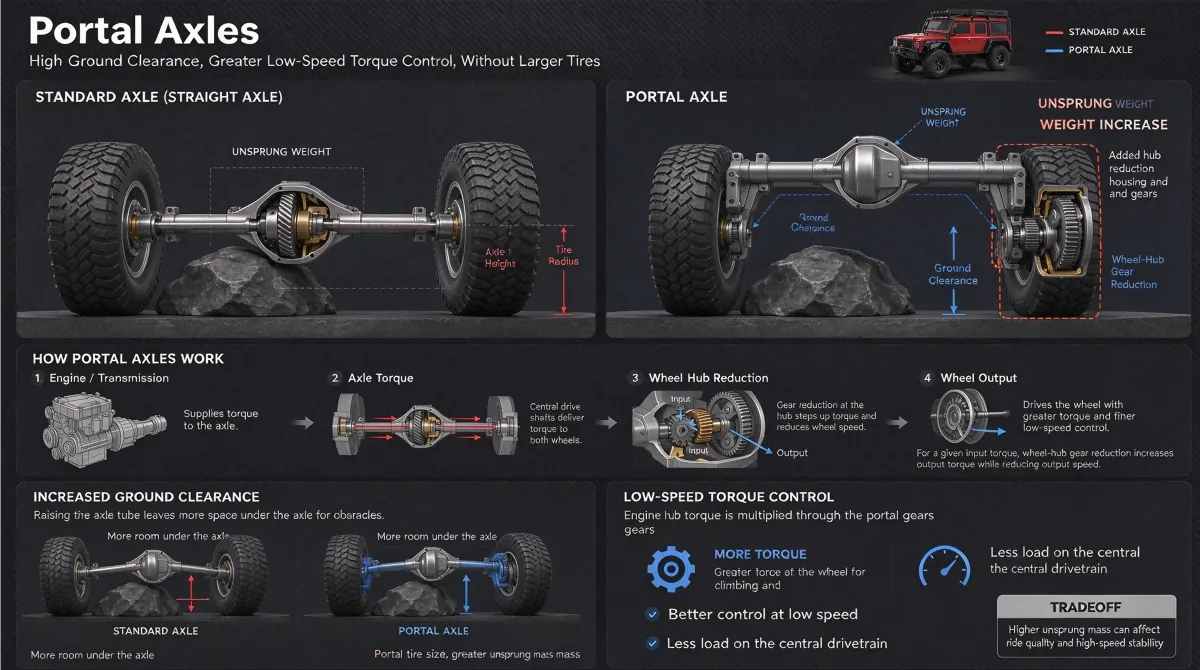
Portal axles are one of the most important innovations in crawler engineering. Instead of routing power directly through the axle centerline, portal axles use a gearbox at each wheel hub to raise the axle tube above the wheel center. The result is significantly more ground clearance without increasing tire size.
The trade-off is complexity. Portal axle gearboxes contain additional gears, bearings, and seals. They require more maintenance and add unsprung weight. But the clearance gain—often close to an inch on 1/10 scale rigs—is transformative on rocky terrain.
Portal axles also introduce built-in gear reduction. A portal gearbox may have a 1.5:1 to 2.5:1 reduction ratio, which means the axle sees less torque stress and the vehicle gains even more low-speed control. Some manufacturers combine a straight front axle with a portal rear axle to balance clearance and stability.
For a 1/8 Scale RC Buggy Wholesale program targeting crawling markets, portal axles are often a selling point rather than a base feature. They represent a meaningful engineering upgrade that justifies a higher price tier.
Low center of gravity is the single most effective defense against rollovers. Every heavy component—battery, motor, ESC, servo—should sit as low and as central as possible within the chassis. Some designs go further by using brass knuckles or wheel weights to add mass exactly where it helps most: at the axle, below the chassis.
Battery placement is a common tuning variable. Moving the battery forward improves climbing traction on steep inclines by transferring weight to the front tires. Moving it rearward improves rear grip on loose surfaces. Many crawler chassis offer multiple battery mounting positions for this reason.
The chassis is the foundation that everything else attaches to. Crawler chassis typically use a ladder frame or C-channel design, often made from steel or aluminum. The frame must be rigid enough to resist twisting under load but not so heavy that it raises the center of gravity.
A 1/8 Scale RC Buggy Wholesale chassis intended for crawling will use thicker frame rails and more cross-bracing than a buggy chassis. The extra material adds weight, but it also prevents the frame from flexing when one wheel is loaded and the others are airborne.
The realism of the scale is a significant factor as well. Many crawler buyers want a chassis that looks like a real truck frame—visible C-channels, cross members, and mounting points that mirror full-size off-road engineering. This aesthetic requirement adds complexity to the design but strengthens the product’s appeal in the hobby market.
Crawler tires are soft, deeply treaded, and designed to conform to irregular surfaces. Tire compound selection is terrain-dependent. Softer compounds grip better on dry rock but wear faster on abrasive surfaces. Firmer compounds last longer but offer less traction on smooth stone. Serious crawler enthusiasts often carry multiple tire sets for different conditions.
Foam inserts inside the tire also matter. A dense insert prevents the tire from folding under load; a softer insert allows more conformity. The right combination depends on vehicle weight, terrain, and driving style.
Outdoors driving can meet rain, mud, and streams sometimes. Crawler electronics must be sealed against water and debris.
Waterproof steering servos, splash-proof receivers, and sealed ESCs are standard on serious crawlers. The ESC also needs adjustable drag brake—a feature that applies braking force to the motor when throttle is released, preventing the vehicle from rolling backward on an incline.
Motor selection favors high-turn brushed motors or low-KV brushless systems. A 540-size crawler motor with a high turn count delivers smooth, controllable torque at low RPM. A low-KV brushless motor offers similar characteristics with better efficiency and longer runtime.
The engineering differences between a crawler and a buggy are structural. A buggy prioritizes speed, airflow, and high-RPM power. A crawler prioritizes traction, articulation, and low-speed control. The suspension geometry, drivetrain ratios, tire compounds, and electronics all reflect that difference.
When a crawler is engineered correctly, the result is a vehicle that can do something no other RC car can: climb a slope that looks impossible, pick a line through a rock garden, and keep moving when three wheels are on the ground and one is in the air.