All the electric RC cars is as good as the batteries feeding them. Voltage determines speed, capacity determines runtime, and chemistry determines how much care the pack demands. A battery that works well in a 1/18 crawler will overheat a 1/8 brushless truggy. A LiPo pack chosen for maximum punch will disappoint a driver who wants long trail sessions.
The modern RC cars rely on three types of battery: nickel-metal hydride (NiMH), lithium polymer (LiPo), and lithium-ion (Li-Ion). Each occupies a distinct position in the market.
NiMH batteries are the traditional option. They are inexpensive, robust, and have good durability. They tolerate full discharge and do not require balance charging. Their weakness is weight: a NiMH pack of comparable capacity is significantly heavier than a LiPo equivalent, and its voltage sags as it discharges, so punch fades toward the end of a run.
LiPo batteries have become the standard for hobby-grade performance. They offer high energy density, low weight, and the ability to deliver large currents on demand. A LiPo holds a steadier voltage through most of its discharge, which means consistent acceleration rather than a gradual decline. The trade-off is sensitivity: overcharging, deep discharging, or puncturing a LiPo can cause fire.
Li-Ion batteries occupy a middle ground. They offer longer cycle life than LiPo and better energy density than NiMH, but they typically deliver lower peak currents. They are common in smaller-scale vehicles where weight and longevity matter more than explosive acceleration.
Chemistry | Energy Density | Peak Current | Care Level | Typical Use |
NiMH | Moderate | Moderate | Low | Entry-level RTR, budget models |
LiPo | High | Very high | High | Performance brushless, racing |
Li-Ion | High | Moderate | Moderate | 1/16–1/18 scale, trail crawlers |
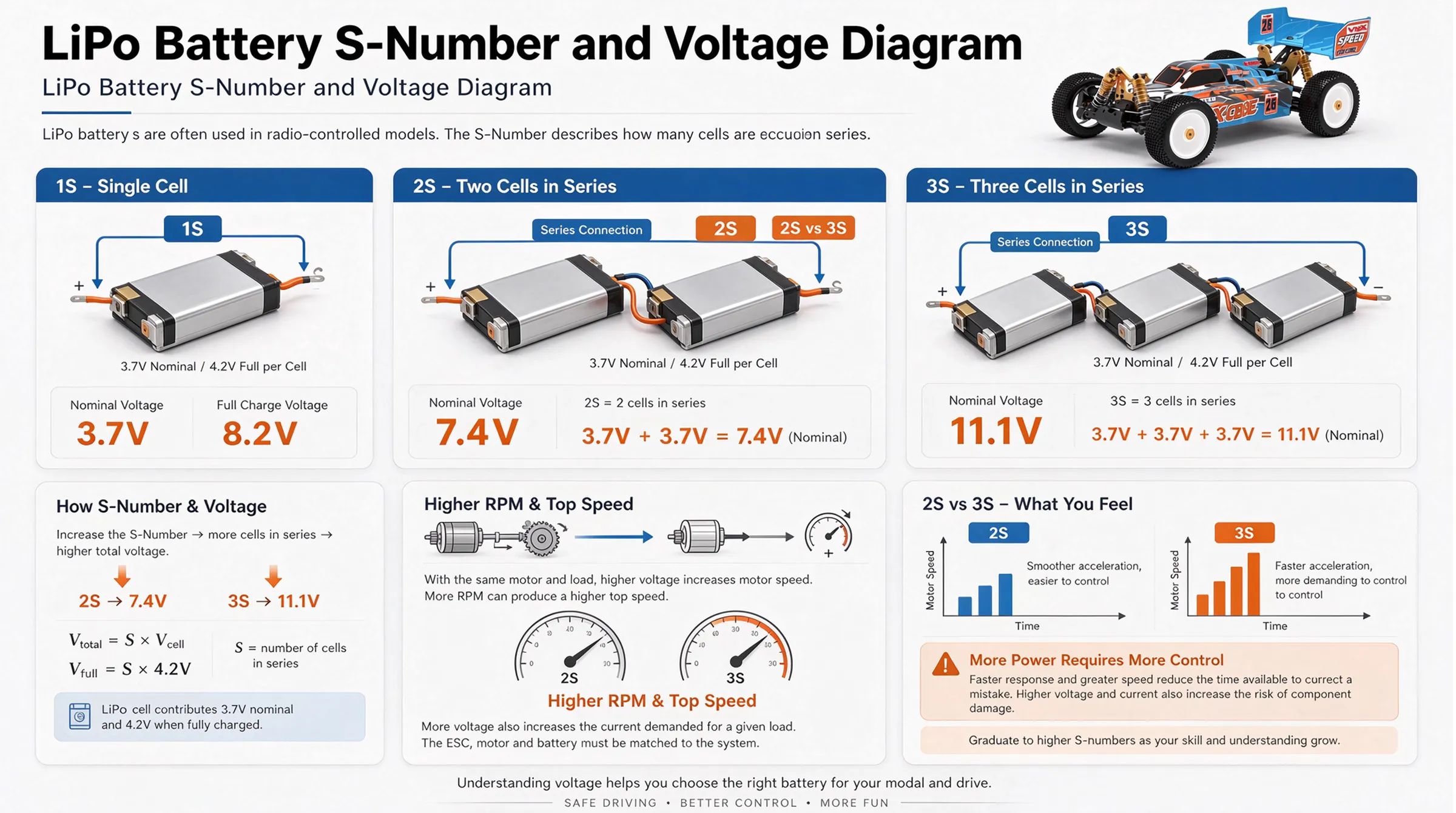
LiPo voltage is described by the number of cells in series, abbreviated with an “S.” A single LiPo cell has a nominal voltage of 3.7V and a full-charge voltage of 4.2V.
Higher voltage raises motor RPM. On the same KV motor, moving from 2S to 3S increases RPM by roughly 50%, which translates into higher top speed and stronger acceleration. Many drivers report a 30–60% increase in peak speed when switching from a quality 2S pack to a compatible 3S pack, assuming gearing and tires remain unchanged.
More voltage is not always better. On tight tracks or in small spaces, the extra speed of a 3S battery can make the car harder to control. For learning throttle control, a 2S pack often remains the smarter choice.
Capacity is measured in milliamp-hours (mAh). A 3300mAh battery stores 3.3Ah of energy. If the vehicle draws an average of 15 amps, theoretical runtime is roughly 13 minutes.
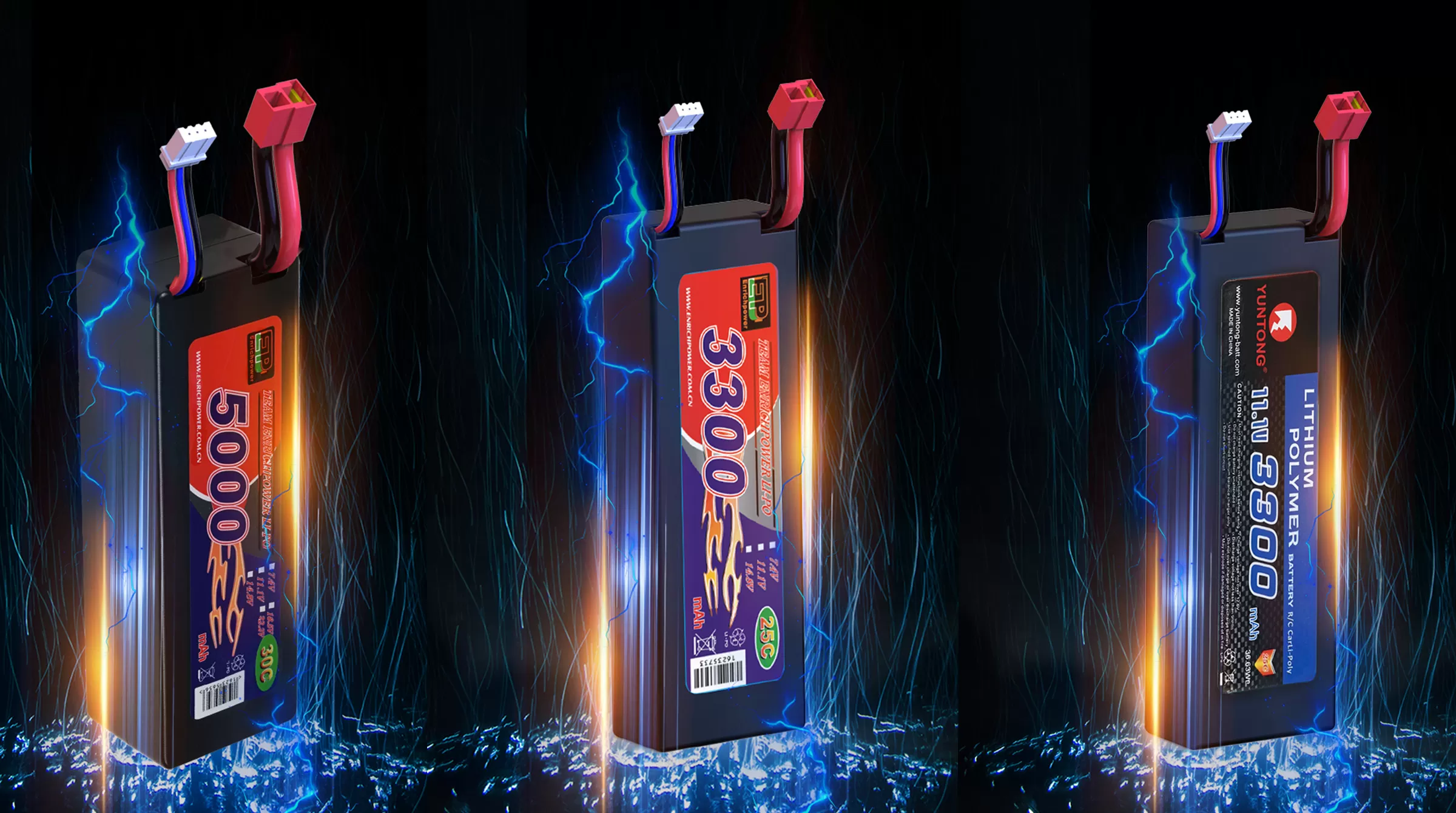
Higher capacity means longer runtime, but also more weight. A 5000mAh pack may extend a session, yet the added mass affects acceleration, handling, and suspension response. For many drivers, a medium-capacity pack—3300mAh to 5000mAh—offers the best balance between runtime and vehicle dynamics.
At identical mAh ratings, a 3S pack usually delivers shorter runtime than a 2S pack. The higher voltage causes the motor and ESC to draw more current under acceleration, draining the battery faster. If you switching from 2S to 3S without changing capacity, you may see 20–30% less run time.
The C rating describes how quickly a battery can safely discharge. Multiply the C rating by the capacity in amp-hours to get the maximum continuous discharge current. A 5000mAh (5Ah) pack rated at 20C can deliver roughly 100 amps continuously.
For a typical 1/10 brushless car, peak current draw under hard acceleration may reach 80–100 amps. A pack with a realistic C rating and sufficient capacity will handle this without excessive voltage sag. Buying an unnecessarily high C rating adds cost without meaningful benefit if the rest of the power system cannot use the extra current.
Many OEM projects specify batteries with C ratings matched to the intended motor and ESC combination. A 1/10 Scale RC Car OEM platform designed for brushed motors may specify a modest C rating, while a brushless racing platform demands more. For 1/8 scale vehicles, larger capacity and higher C ratings are typically required to feed the more powerful electronics.
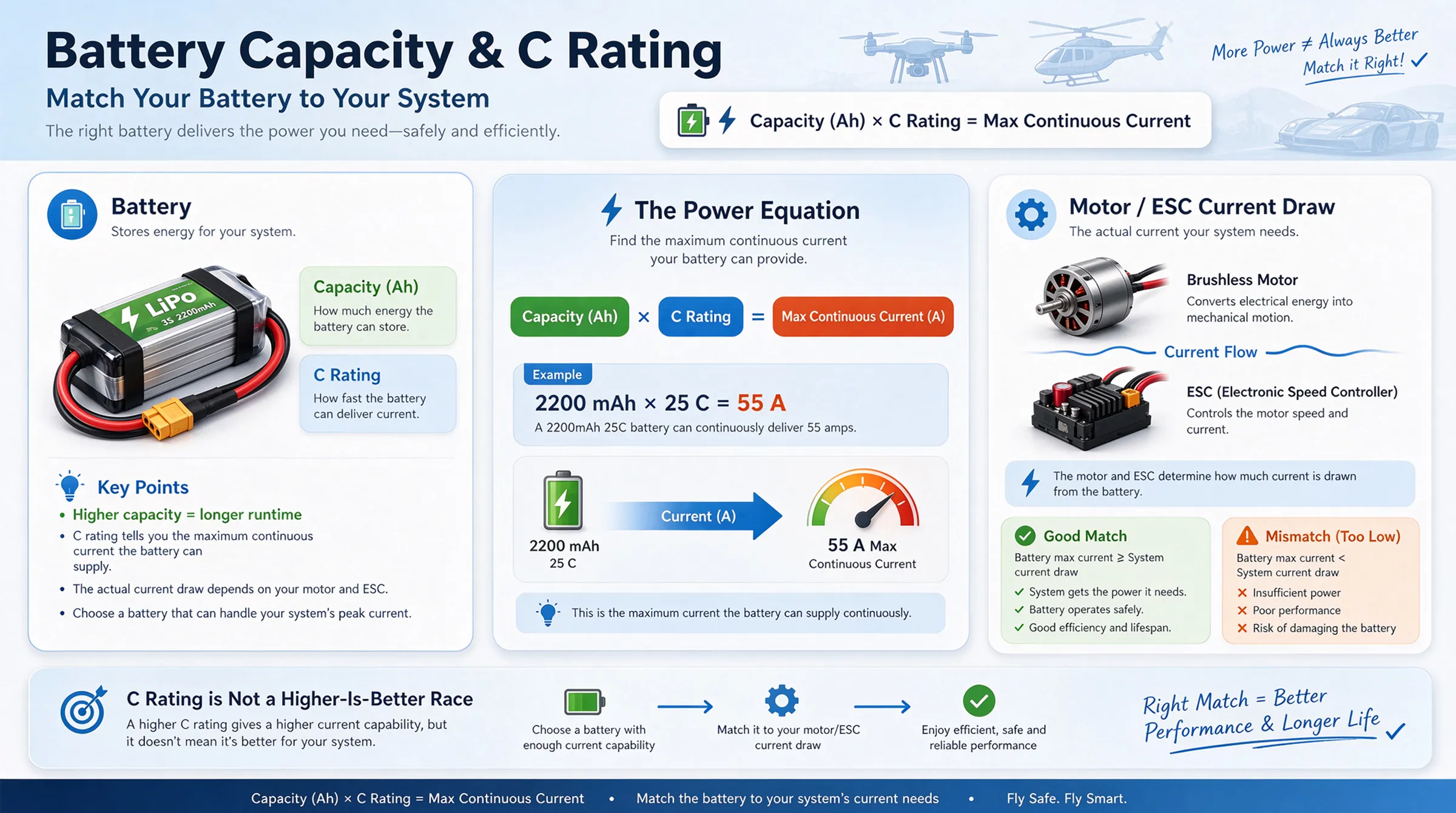
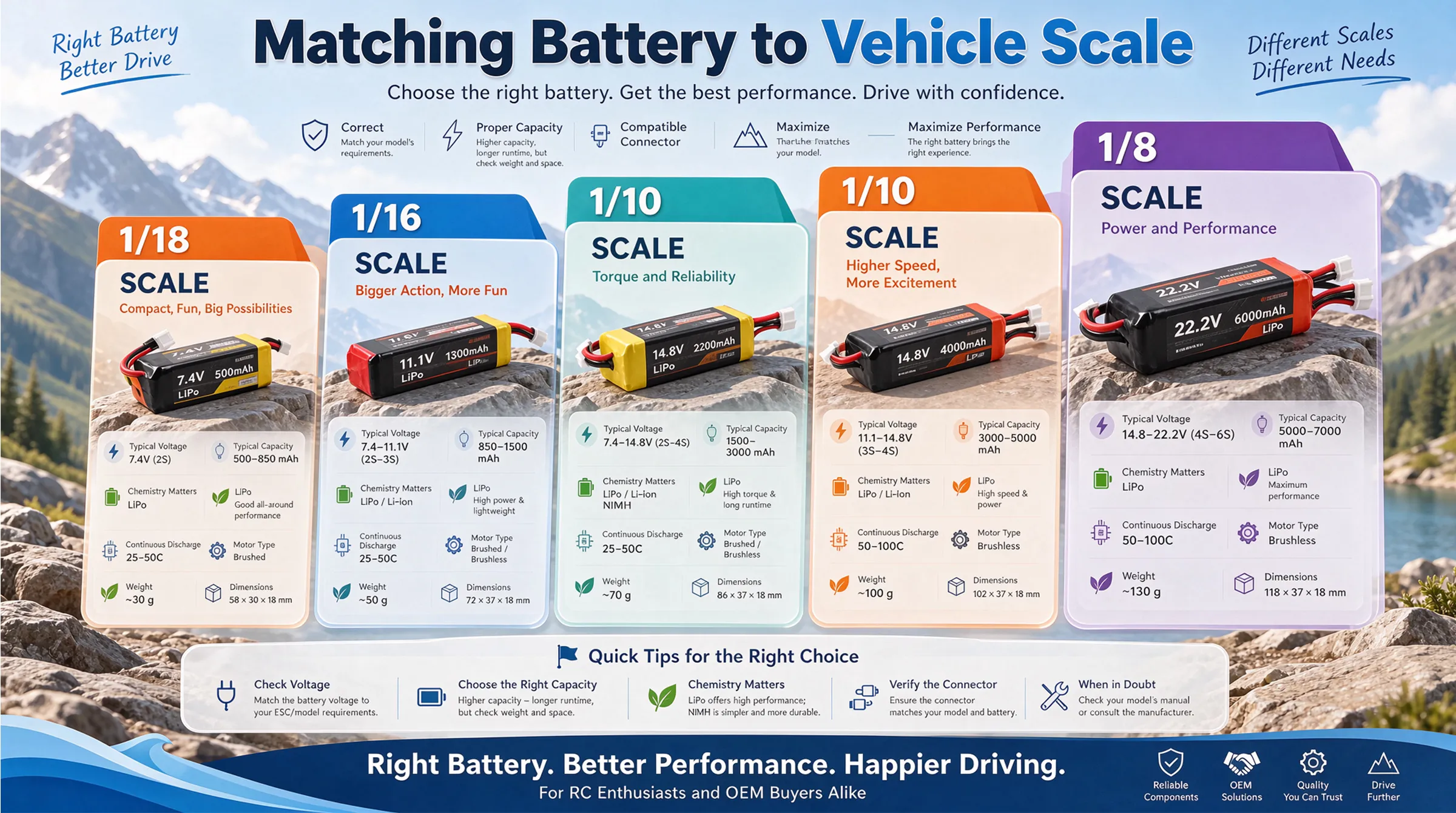
Battery requirements vary significantly by scale. A 1/18 crawler may use a 7.4V Li-Ion pack of 600–1300mAh. A 1/10 brushless buggy typically runs a 2S or 3S LiPo in the 3000–5000mAh range. A 1/8 electric truggy demands a 3S or 4S LiPo with 5000mAh or more and a high C rating.
VRX Racing’s product range reflects these differences. The company offers 7.4V 1300mAh 2S LiPo packs for its 1/16 and 1/18 brushless models, and 11.1V 3300mAh 3S LiPo packs for selected 1/8 and 1/10 electric vehicles. A 1/8 Scale RC Buggy Wholesale program would typically specify higher-capacity packs to support the larger motors and longer runtimes expected at that scale.
Scale | Typical Voltage | Typical Capacity | Chemistry |
1/18 | 7.4V (2S) | 600–1300mAh | Li-Ion or LiPo |
1/16 | 7.4V (2S) | 1300–2000mAh | LiPo |
1/10 brushed | 7.2V NiMH / 7.4V 2S | 1800–3300mAh | NiMH or LiPo |
1/10 brushless | 7.4V–11.1V (2S–3S) | 3000–5000mAh | LiPo |
1/8 electric | 11.1V–14.8V (3S–4S) | 4000–6500mAh | LiPo |
Voltage sag is the temporary drop in voltage under load. A battery with high internal resistance will sag more, delivering less effective voltage to the motor. This shows up as reduced punch, slower acceleration, and inconsistent throttle response.
LiPo packs sag less than NiMH under equivalent loads, which is one reason they feel more powerful. But even LiPo performance degrades over time.
The internal resistance rises with age and poor storage habits. A well-cared-for LiPo retains its punch for hundreds of cycles; a neglected pack loses it within dozens.
For OEM buyers, battery selection is not a one-time decision,for the battery must be matched to the vehicle’s weight, motor, ESC, and intended use case.
LiPo batteries require more care than NiMH or Li-Ion. The most important habit is storage voltage. LiPo packs should be stored at approximately 3.8V per cell—roughly 50% charge. Leaving a LiPo fully charged for extended periods causes problems, such as the pack to puff, lose capacity, and develop voltage imbalance. The correct procedure is to use the charger’s storage mode to bring each cell to 3.7–3.85V before storing the battery in a LiPo-safe fireproof bag or metal box, in a cool, dry location.
NiMH batteries are safer to use. They can be stored at partial charge without the same risk of permanent damage, though they still benefit from periodic cycling. Li-Ion packs fall between the two: less sensitive than LiPo, but still requiring moderate storage voltage.
A few safety rules apply to all lithium chemistries:
Never charge a damaged, swollen, or punctured pack.
Never charge unattended.
Never charge a cold battery immediately after winter running—let it return to room temperature first.
Use a charger specifically designed for the battery chemistry. Charging a LiPo with a NiMH charger can cause fire.
Store packs in a fireproof container, not loose in a toolbox or car trunk.
Battery Type | Storage Voltage | Storage Container | Check Interval |
LiPo | ~3.8V per cell | LiPo-safe bag or metal box | Every 1–2 months |
NiMH | 40–60% charge | Dry, cool location | Every 2–3 months |
Li-Ion | ~3.7V per cell | Dry, cool location | Every 2–3 months |
The best choice of battery depends on what the vehicle is for.
For a beginner RTR model, a NiMH pack may be perfectly adequate. It is cheap, safe, and simple. A 1/10 Scale RC Car OEM platform designed for entry-level buyers often ships with NiMH to keep the price accessible and reduce the risk of user error.
For a performance brushless platform, LiPo is the only realistic choice. The motor and ESC are designed around LiPo voltage curves, and the vehicle’s weight and balance assume a LiPo pack.
For a small-scale trail crawler, Li-Ion offers a useful compromise: enough current for slow-speed torque, longer cycle life, and less sensitivity to storage conditions than LiPo.
For distributors and brands commissioning RC vehicles, battery specification should be part of the development brief from the beginning. The brief should state:
Required voltage and cell count (2S, 3S, or other).
Minimum capacity in mAh.
Minimum C rating based on expected current draw.
Connector type (Deans, XT60, or other).
Physical dimensions and mounting constraints.
Battery chemistry preference (NiMH for budget, LiPo for performance, Li-Ion for compact models).
The battery choice affects the charger that ships with the vehicle, the ESC rating, the chassis layout, and the packaging. Changing the battery specification late in development means rechecking every one of those downstream decisions. Specifying it early saves time and reduces the risk of incompatibility.