Off-road RC cars face more stress than vehicles used on smooth pavement. Dirt enters moving parts, landings load the suspension, and acceleration strains gears, shafts, and tires. Even a well-built model can wear quickly if its setup and maintenance do not match the terrain.
Durability is not about making every component heavier. It means reducing impact, keeping parts clean and adjusted, and replacing wear items before they damage other systems.
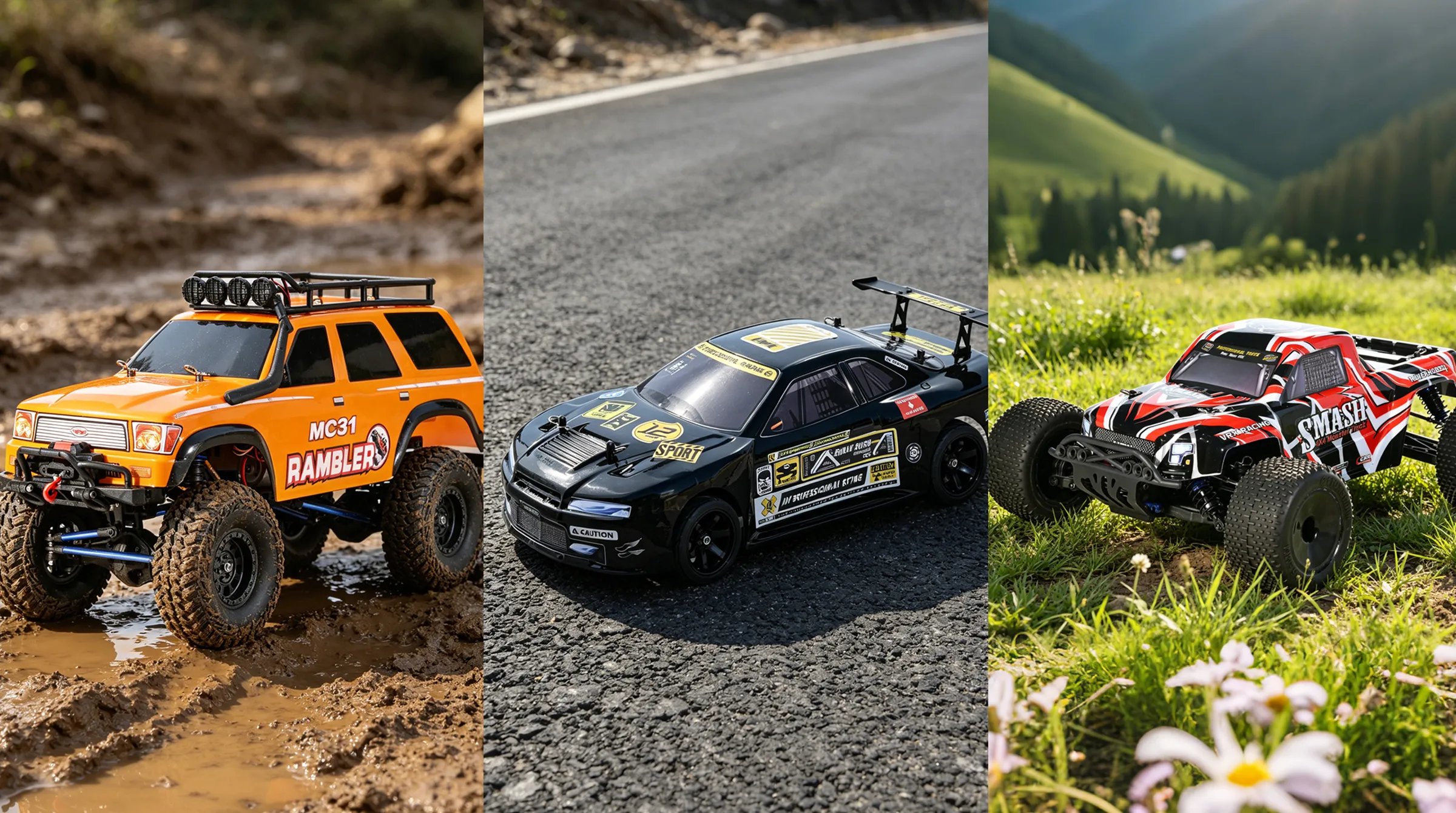
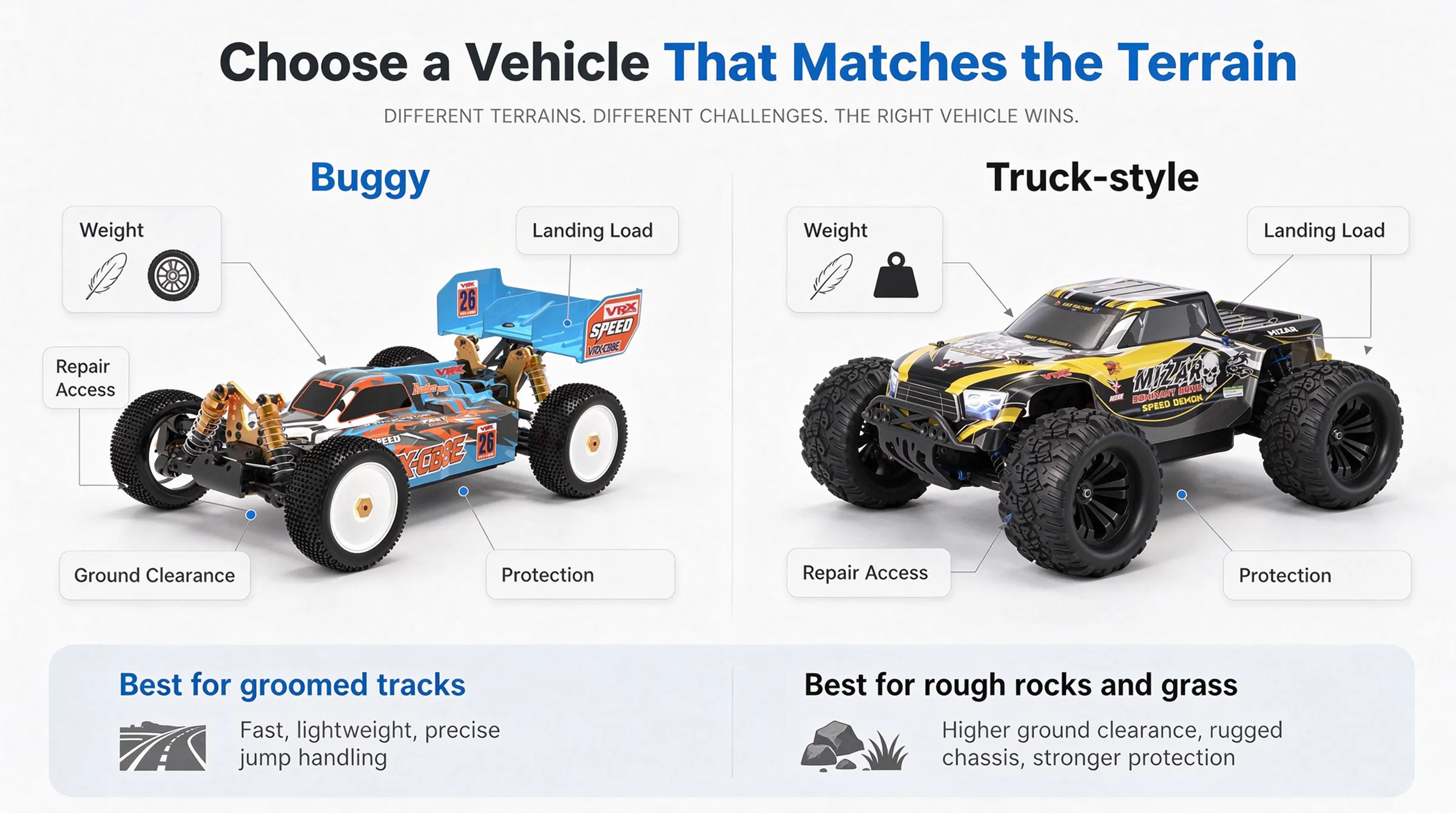
Match the vehicle to its usual terrain. A light buggy can be agile on packed dirt and prepared tracks, while a truck-style platform may provide more clearance on rough ground.
Larger models can fit robust components, but their extra weight increases landing loads.
Before choosing a model, consider:
Surface: Fine sand, loose gravel, mud, grass, and rocky trails each create different traction and cleaning demands.
Driving style: High-speed racing, casual bashing, and slow obstacle driving place different loads on the chassis and drivetrain.
Repair access: Common replacement parts should be easy to identify and install.
Protection: Look for sensible coverage around gears and electronics, plus bumpers and suspension components suited to the intended use.
For specifications and support information, visit VRX racing before choosing a model.
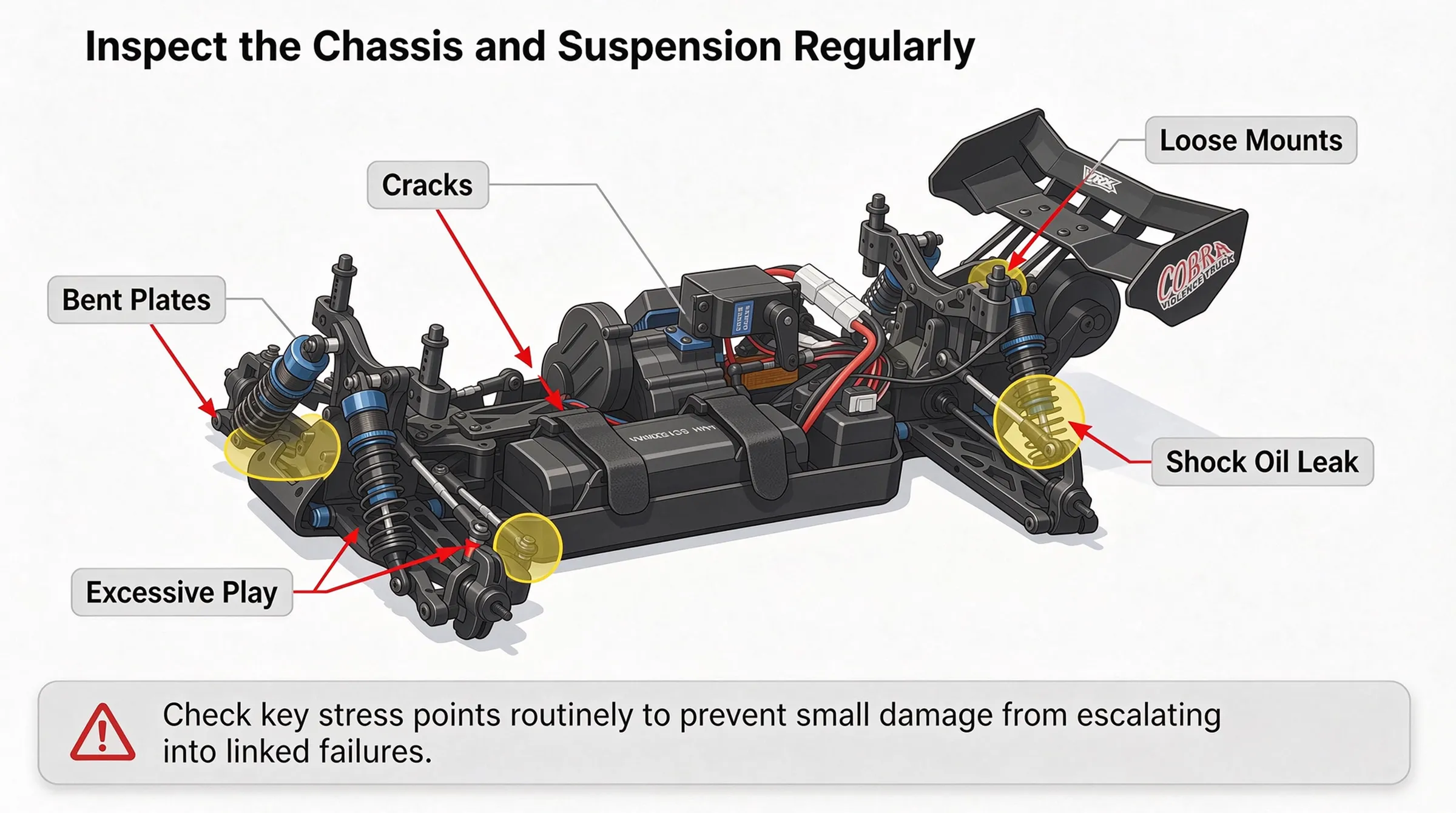
The chassis takes the loads that pass between the wheels, suspension, and drivetrain, so check it first after a hard landing or collision. Look for cracks, bent plates, loose mounts, and any sign of rubbing. A bent chassis or shock tower can knock alignment out and put extra stress on nearby parts.
Then inspect the suspension arms, hinge pins, shock towers, and dampers. Watch for hairline cracks, excessive play, leaking shock oil, bent shafts, and loose rod ends. Press down each corner of the car; the suspension should move smoothly and return consistently.
Do not tighten every screw as hard as possible. Over-tightening can strip threads or prevent suspension parts from moving freely. Tighten fasteners securely, use thread-locking compound only where the manufacturer recommends it.
If a part is damaged, replace it instead of gluing a highly stressed joint. Glue may be acceptable for a cosmetic crack in the body, but a suspension arm, steering part, or drivetrain component must be able to handle repeated loads.
Off-road driving changes wheel resistance constantly. When one tire grips and another spins, differentials, driveshafts, gears, and bearings take extra load. Four-wheel drive helps maintain traction, but its moving components need regular inspection.
On a 4wd RC tuggy, check the center and wheel driveline for trapped grass, string, sand, and small stones. Debris wrapped around a shaft can restrict movement or damage seals.
With the vehicle safely powered off, spin the wheels by hand. Grinding, binding, or unusual looseness can point to a damaged bearing, gear, or joint.
Key drivetrain checks:
l Gear mesh: Inspect the motor pinion and spur gear for worn or chipped teeth. Incorrect mesh can create excess heat and noise.
l Bearings: Clean accessible bearings and replace those that feel rough, seize, or show excessive play.
l Differentials: Follow the manual’s service interval and use only the recommended lubricant or fluid.
l Drive shafts and joints: Check for bends, worn pins, damaged boots, or excessive movement.
l Wheel nuts: Confirm that wheels are secure without binding against adjacent components.
Avoid adding more lubricant than needed, because excess grease can attract grit, and even become an abrasive paste. Remove dirt first, apply the specified lubricant sparingly, and keep the drivetrain dry and clean where the design requires it.
Tires affect durability as well as grip. Choose tire size, tread, and compound for the usual surface.
Check tires for torn lugs, split sidewalls, loose inserts, and separation between the tire and wheel. A wheel that is cracked or out of round can cause vibration and add stress to bearings and suspension parts. Replace badly damaged tires in pairs on the same axle when practical, so grip remains balanced.
The body shell protects the internal parts from direct contact with dirt and debris, so checking and repairing the shell is also important. Repair cracks before they spread, and inspect body clips or clipless mounts after impacts.
Use the factory bumper and guards as intended. Extra metal accessories may appear stronger, yet unnecessary weight can increase the force transmitted to the chassis and suspension during a crash. Add protection only when the benefit matches the terrain and the vehicle’s design.
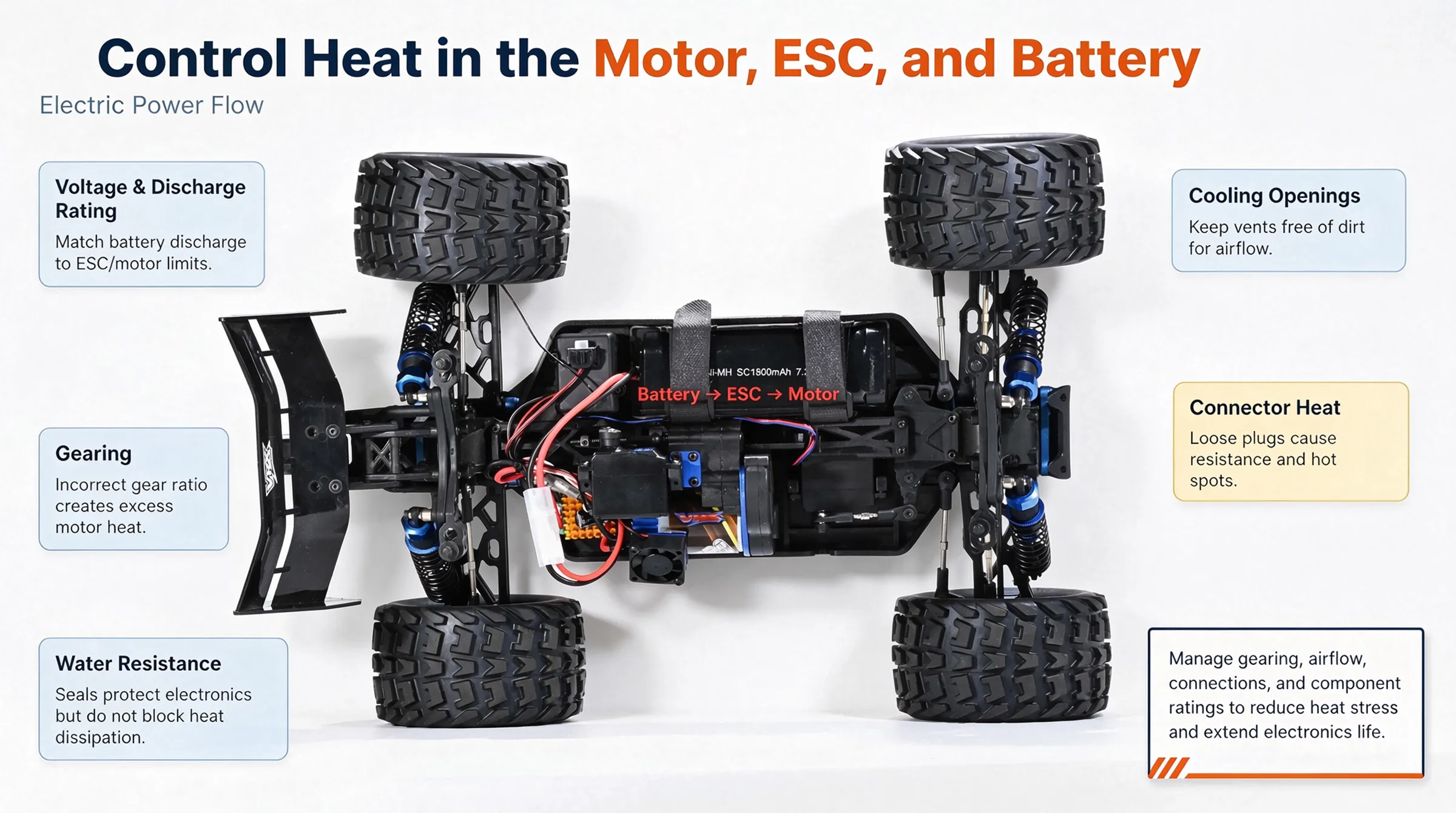
Heat shortens component life. Deep grass, thick mud, oversized tires, or unsuitable gearing can overload the motor and electronic speed controller (ESC). If performance fades or components become unusually hot, stop and investigate.
A brushless electric RC car can deliver strong acceleration, but the high power requires correct gearing and cooling. Use the manufacturer’s recommended motor, ESC, battery, and gearing combinations.
To limit electrical wear:
1. Keep cooling openings clear of mud, grass, and dust.
2. Check wires, connectors, and solder joints for looseness or heat damage.
3. Allow the motor, ESC, and battery to cool between demanding runs.
4. Use only batteries with the correct voltage and suitable discharge rating.
5. Stop immediately if a battery is swollen, damaged, or unusually hot.
Water resistance is not the same as complete waterproofing. Confirm the protection level of each component before driving through puddles or wet grass. After a damp run, disconnect the battery, remove dirt and moisture, and dry the vehicle thoroughly.
For safety, never charge a wet or damaged battery.
Driving habits strongly affect part life. Nose-first landings, high-speed collisions, and full-throttle runs over deep ruts heavily load the chassis and suspension.
Lift off before large bumps, keep the car level during jumps, and avoid landing while steering sharply. If a jump is too large for the vehicle’s suspension travel, choose a smaller line rather than trying to solve the problem with stiffer springs alone. Excessively stiff suspension can transfer more impact into the chassis instead of absorbing it.
Use throttle smoothly on high-grip surfaces. Sudden acceleration can shock gears and driveshafts; sudden braking can pitch the vehicle forward. In mud or loose sand, avoid forcing the motor to turn wheels that are fully trapped.
When | Checks and actions |
Before each run | Check battery condition, wheel nuts, steering response, throttle/brake function, and visible cracks. |
After each run | Remove dirt and grass; inspect tires, suspension arms, shafts, body mounts, and cooling openings. |
After a hard impact | Check chassis alignment, shock towers, hinge pins, steering links, gears, and wheel bearings before driving again. |
Every few sessions | Inspect shock oil and seals, check gear wear and differential condition, and service bearings according to the manual. |
Before storage | Clean and dry the vehicle, disconnect the battery, and store batteries at the manufacturer’s recommended charge level and conditions. |
Use a soft brush, a cloth, and an air blower set to a safe pressure to remove debris. Do not use high-pressure air; it can push dirt deeper into bearings or electronics.
If you clean the RC car with water, first confirm that the model's components can tolerate it. Dry the vehicle completely afterward.
Some components wear by design and cost less to replace than the parts they protect, so replacing them when necessary is more economical. Inspect tires, gears, bearings, shock seals, hinge pins, and suspension links, and replace the parts with cracks, rounded teeth, binding, or excessive movement.
Use compatible replacement parts with the correct dimensions and material properties. A part that is harder or heavier is not automatically better: it may transfer the force of an impact into a more expensive component. When upgrading, change one item at a time and test the result before adding more modifications.
It is a useful choice to keep a small repair kit with the tools and spares that match your model. Typical essentials include the correct hex drivers, wheel nuts, body clips, suspension pins, common fasteners, and frequently damaged arms or gears.
Remember to record the recurring failures. If the same part repeatedly fails, review the setup and driving conditions instead of replacing it without investigating the cause.