Wheel-and-FPV RC projects have been turning up in malls, karting venues and exhibition halls, and most enquiries about them ask the same two things: how big a floor do I need, and what does it cost to run. This piece answers those, and then looks at the hardware itself — what a station is made of, and which of its features actually matter once the venue is open. No prices; just the numbers and the logic behind them.
A customer sits at a simulator wheel and presses the throttle; a real RC car on the floor moves. A camera on the car sends the view back to the screen in front of them, and the lens sits roughly ten centimetres off the ground. That height is the whole point: the customer is not looking down at a toy, they are driving from the seat of a 1/10 car. Braking distance, corner entry and the sense of speed all follow real-car logic, which is why people take to it faster than they do to a normal RC car.
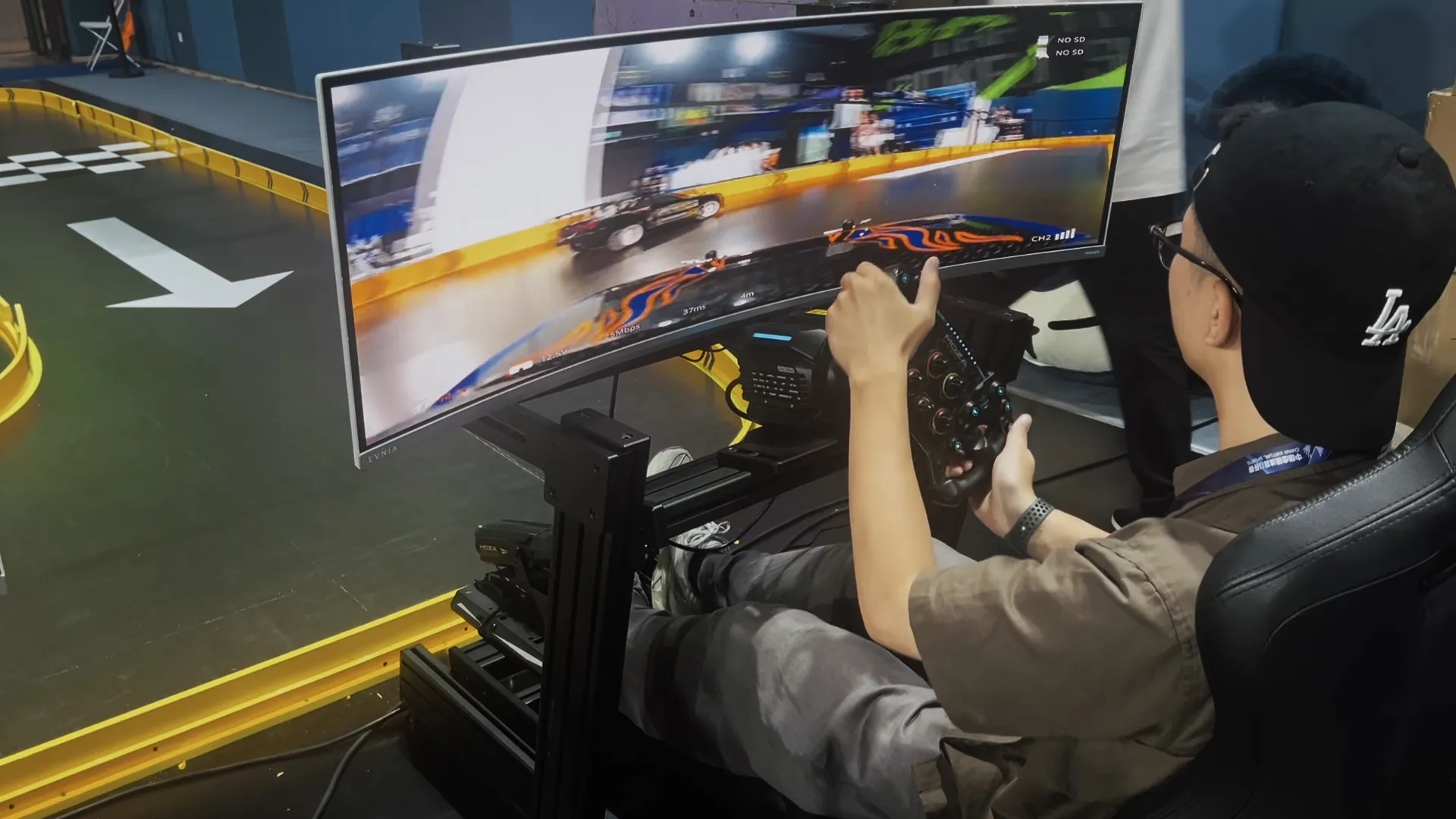
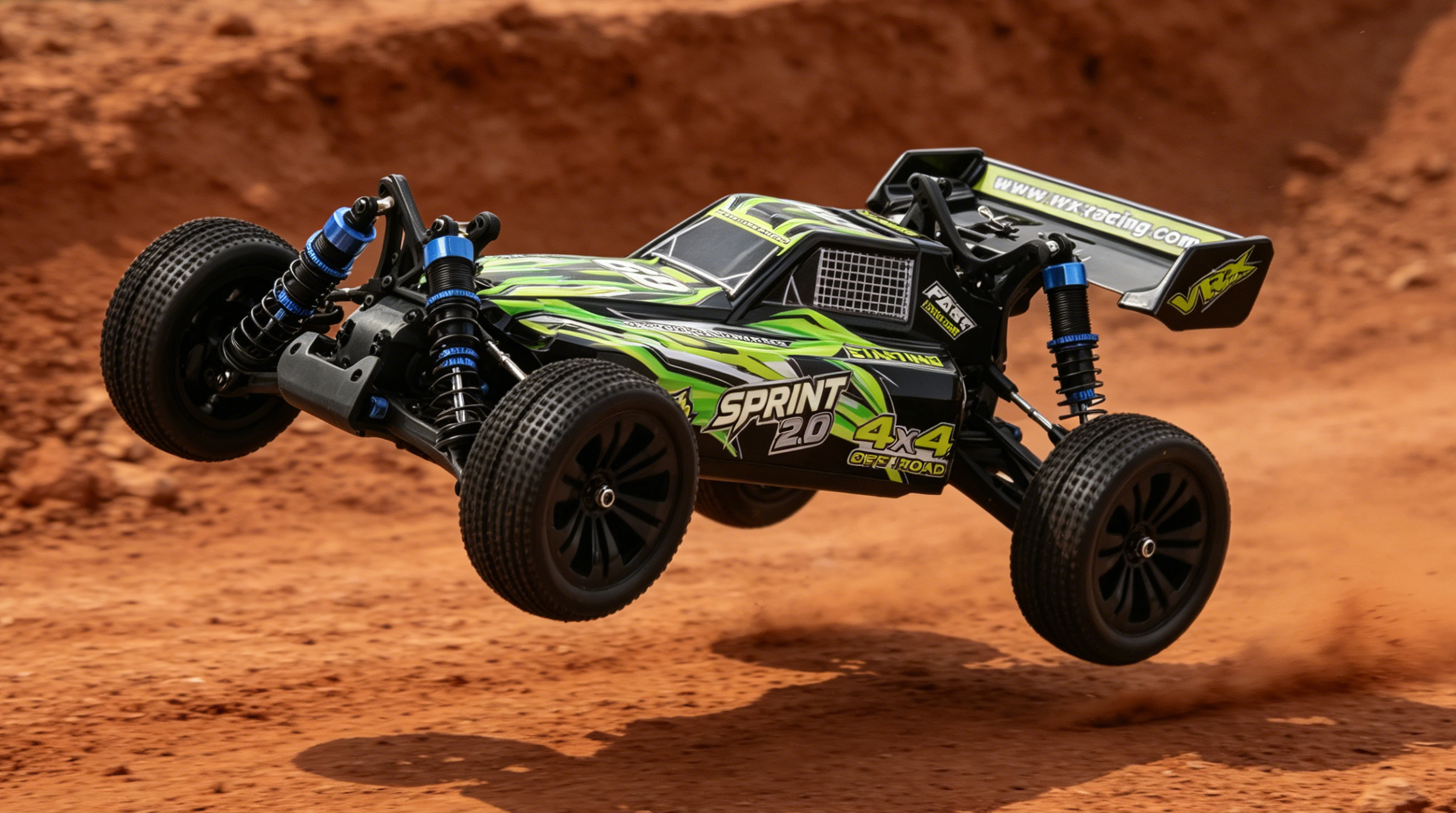
The platform is built in three blocks, and each block can be swapped or upgraded on its own. The control end is a MOZA R5 direct-drive base with the ES wheel and SRP Lite pedals, mounted on a 15-degree desk clamp — or bolted into a cockpit if the venue wants one. The signal end is the proprietary conversion module — the “black box” — plus a DUMBORC DDF-350 ten-channel transmitter and the PPM coach cable that lets the two control styles take turns on the same car. The execution end is a VRX Racing 1/10 brushless 4WD buggy with a Walksnail Avatar HD link already fitted to the shell.
What the platform gives you
Item | Specification | Why it matters in a venue |
Steering | Direct-drive base; wheel travel mapped to the car from 180° to 900° | Lower mapping equals a quicker, more sensitive car — tune it to the age group |
Signal | 10 channels fully mapped: steering, throttle/brake plus 6 auxiliary | Leaves room for lights, sound, head tracking and future add-ons |
Video | 1080p or 720p, about 22 ms end-to-end, 25–1200 mW (FCC), 8 channels | Low enough latency to drive competitively; eight channels let several cars run at once |
Recording | Built-in DVR and live OSD: voltage, bitrate, latency, channel, SD status | Faults show up on the screen before they become a customer complaint |
Vehicle | 1/10 brushless 4WD buggy, 7.4V LiPo, balance charger, gyro receiver | Gyro keeps the car straight and reduces rollovers on a tight indoor track |
Compatibility | MOZA, Logitech G29 and GRS50, Keten; DAC and PPM output | Existing simulator hardware can be reused instead of replaced |
Four things tend to come up once operators have run it for a while. First, one station serves two kinds of customer: pull the coach cable and the same car runs on a pistol grip, so first-timers and sim racers share equipment. Second, the feel is adjustable rather than fixed — the wheel’s limit angle is set in the driver, the black box maps it onto the car’s actual steering, and throttle and brake curves are set in MOZA Pit House, so a track for eight-year-olds and one for adults can use identical hardware. Third, the OSD is an operations tool: bitrate, latency, both battery voltages and channel occupancy are on screen, which is how a marshal spots a weak link before a session starts. Fourth, the wearing parts are tyres, packs and antennas, not electronics — and the same control station drives a 1/24 or a 1/10 car by changing the shell.
Most layout mistakes come from the same place — treating the floor as a plane that only has to fit a track. Raise the barriers and the problem appears immediately: a barrier 30 cm high, five metres ahead of the camera, hides everything below 50 cm at ten metres. What it blocks is not the car; it is the next corner. The customer stops dead in the racing line and waits for someone to walk out and fetch the car.
That is why these projects use low edging rather than walls: strips 12–15 cm high and 5–8 cm wide, which define the track and still leave the view intact. This ratio decides whether a floor can host a track long before total area does.
Minimum and recommended space, and car count
Car size | Minimum area (1–2 positions) | Recommended area (4 positions) | Track size | Cars for 4 positions | Fits best in |
1/24 (about 20 cm) | about 45 m² | about 130 m² | 8 × 5 m | 5 cars (4 running + 1 spare) | Mall atrium, storefront, family venue |
1/18 (about 25 cm) | about 80 m² | about 165 m² | 12 × 7 m | 5 cars | RC club, side area of a karting venue |
1/10 (about 40 cm) | about 175 m² | about 340 m² | 20 × 10 m | 5 cars | Warehouse unit, standalone site |
At an exhibition in Anhui we ran three 1/10 touring cars at once on about 150 m². A show floor can be pushed to that density. A permanent venue cannot: it needs room to recover a car, hold a queue and keep spectators out of the racing line, which is why the recommended figures sit wider than a show build.
There is a second rule that gets missed: double the car and you do not double the floor. A 1/10 car is twice the length of a 1/24, but the area it needs is around five times larger. Braking distance, the walk to retrieve a rolled car, and the simple requirement that staff must be able to reach the car all grow at the same rate or faster.
A four-position venue usually runs four cars and keeps one spare. The spare is not there for breakdowns; it is there for turnover. A pack lasts five to six minutes, and swapping batteries, wiping the car and logging the session takes two to three more. Only a spare car and spare packs hold that rhythm together.
Batteries must be planned as a swap operation, not a charging one. The charger in the box is an entry unit that needs hours for a 5000 mAh pack, so the venue runs on packs changed at the counter: three to five per position, topped up overnight.
Budgets almost never blow up on the car. They blow up on the floor, the barriers and the spares. Five lines cover the entire project, and only one of them is equipment you buy.
The five budget lines
Line | What it covers | How it scales | Can it be cut? |
Station hardware | Car, camera and video link, black box, batteries, charger | One to one with position count; the largest line | No — start with fewer positions instead |
Wheel and pedals | Direct-drive base and pedals, or a pistol grip | About 30 percent of a complete station | Yes — start on pistol grip, add wheels later |
Screen and cockpit | Monitor on a clamp up to a full profile cockpit | The widest range in the project | Yes — most of the savings live here |
Track and floor | Barrier modules, flooring, markings, levelling | Priced by perimeter, not by position | Floor no; decoration yes |
Spares and batteries | One spare car per 4–6 positions, tyres, gears, 3–5 packs per position | About 10–15 percent of hardware | No — this is what keeps you open |
What separates the tiers is rarely the electronics. It is whether the venue wants a proper cockpit and a permanent track, and whether the floor can carry them.
Three tiers and the order of magnitude
Tier | Positions | Car size | Cars | Budget level |
Essential | 1–2 | 1/24 | 2–3 incl. spare | A few thousand USD |
Standard | 4–6 | 1/24 or 1/18 | 5–7 incl. spare | Around ten thousand USD and up |
Flagship | 6–10 | 1/10 | 7–11 incl. spare | Twenty thousand USD and up |
These levels cover equipment, barrier track and the first batch of spares and batteries. Shipping, duty, fit-out and rent sit outside them; inside one tier, screen size, cockpit style and custom shells move the figure by a noticeable margin.
On our own list, a 1/10 station costs about one tenth more than a 1/24 station, while the track it needs is roughly five times larger — 200 m² against 40 m² in the recommended build. Choosing 1/10 is not buying a bigger car. It is renting a much bigger room, and the room is the monthly bill.
Per square metre, 1/24 earns several times what 1/10 earns, as long as it is run well. 1/10 pays back through ticket price and dwell time, not through density. If the site cannot carry the floor, 1/10 does not save money — it just makes the room look empty.
List BulletOrdering before measuring. The track is drawn around the room, not the other way round.
List BulletUsing leasing area as usable area. The plan says 300 m²; the tape says 240, with two columns sitting on the racing line.
List BulletBuilding barriers like advertising walls. They photograph well and destroy the FPV view. Branding belongs on the floor and the entrance, not at camera height.
List BulletOne battery per car. Fine in a demo video, finished by the first Saturday.
List BulletTreating 1/10 as the upgrade. It is an upgrade of the venue, not of the product.
1. What is included, and what do I buy separately?
The standard set covers all three blocks: the control end (MOZA R5 base, ES wheel, SRP Lite pedals, 15-degree clamp), the signal end (black box, its power lead, PPM coach cable, DDF-350 ten-channel transmitter), and the execution end (the 1/10 brushless buggy, 7.4V pack and balance charger, shell-mounted video transmitter and ground receiver). Plan separately for the monitor with HDMI input, a stand or cockpit and seat, a 3S–4S pack and matching DC adapter for the ground unit, four AA cells for the transmitter, a longer HDMI cable, barriers and flooring, and spare packs and parts.
2. How is it wired, and do I need a computer?
The chain runs: base USB-B to a PC, base USB to the black box, black box to the DDF-350 coach port over the PPM cable, transmitter paired to the receiver in the car, shell transmitter to ground receiver, then HDMI to the screen. A PC is needed only while setting up — MOZA Pit House for wheel limit angle, pedal curves and self-centring. Day-to-day operation needs no computer: channel direction, neutral and endpoint are all set on the black box display.
3. How much floor do I need?
See Table 2: about 45 m² minimum and 130 m² recommended at 1/24; 80 and 165 m² at 1/18; 175 and 340 m² at 1/10. The recommended figures assume four positions and already include room to recover a car and hold a queue.
4. Does it work with my own wheel and screen?
The wheel side works with MOZA, Logitech G29 and GRS50, and Keten — select the wheel in the black box settings. Output is available as DAC or PPM, which covers most receivers. Any monitor with a standard HDMI input at 1080p or 720p will do: a TV, a commercial display or a desktop screen. Changing the shell moves the same station from 1/24 to 1/10.
5. How many cars at once, and will they interfere?
The video link offers 8 channels in FCC mode and 4 under CE/SRRC, so each car takes a different channel and they run together — four to six cars on one floor is routine. Interference comes from overlapping channels, metal structures and other 5.8 GHz gear, so sweep the site at the busiest hour before opening and fix each car to its channel; keep the spare on a separate channel, or unpowered.
6. How far does the video reach, and what is the latency?
About 22 ms end to end at 1080p, a little lower in 720p high-frame-rate mode — enough for racing. Range follows power: 25 mW is fine for tens of metres indoors, 700 mW reaches hundreds of metres in the open, and FCC mode goes to 1200 mW. On a 20 × 10 m track you use none of that range; interference, not distance, is what you manage, and the OSD shows distance and signal bars directly.
7. How long does a pack last, and how long to charge?
The 7.4V 5000 mAh pack gives about five to six minutes; swapping and wiping takes two to three, and that is the session rhythm. The charger supplied is an entry unit needing hours per pack, so a venue runs on swaps rather than charging: three to five packs per position, changed at the counter and topped up overnight. The ground unit runs on its own 3S–4S pack, also swapped per session.
8. How fast is the car, and can it count laps and rank drivers?
Top speed of the 1/10 brushless 4WD depends on gearing and pack, and an indoor track rarely uses it. Endpoint settings in the black box cap throttle travel, which is the easy way to slow the car down for beginners. Lap counting, timing and ranking are not part of the standard set — add a timing system, infrared or RFID both work; the on-board DVR records every session for review and manual timing.
9. Is there an emergency stop or remote takeover?
The transmitter has failsafe, set to brake or centre on signal loss, and pulling the coach cable hands control straight back to the pistol grip — that is the most direct stop. At venue level, add a master kill switch for the track power. A remote management platform is not included; it can be scoped per project.
10. What does after-sales cover?
Warranty follows the order terms; every shipment includes the full manual, wiring diagram and tuning guide. Remote technical support, operator training before opening and long-term spare parts supply are part of the service, as are OEM/ODM requests for shells, UI, parameter presets and cockpit integration.
Every figure above is net usable area or a structural ratio; landing it on a specific site still takes a floor plan, column positions, circuit capacity and a radio survey. Two practical notes: fit the antennas before applying power, and in FCC regions channels 1, 2, 6 and 7 are amateur bands — for commercial use, stay on the CE/SRRC set.