Few problems are more frustrating than an RC car that runs fine at partial throttle but suddenly cuts out the moment you demand full power. The car accelerates hard, then the power drops, stutters, or disappears completely. This symptom—commonly dESCribed as “RC car cuts out under throttle” or “RC car loses power”—is almost always related to the power delivery system: the battery, the connectors, or the ESC.
This guide walks through the most common causes in logical order and explains how to diagnose and fix each one. The focus is practical troubleshooting for 1/10 and 1/8 electric platforms using modern brushless systems.
Full throttle places the highest current demand on the entire power system. At partial throttle the current draw is moderate; under wide-open throttle the motor and ESC can pull two or three times more amps. Any weak link in the chain—battery, connector, wiring, or ESC—will reveal itself exactly at that moment.
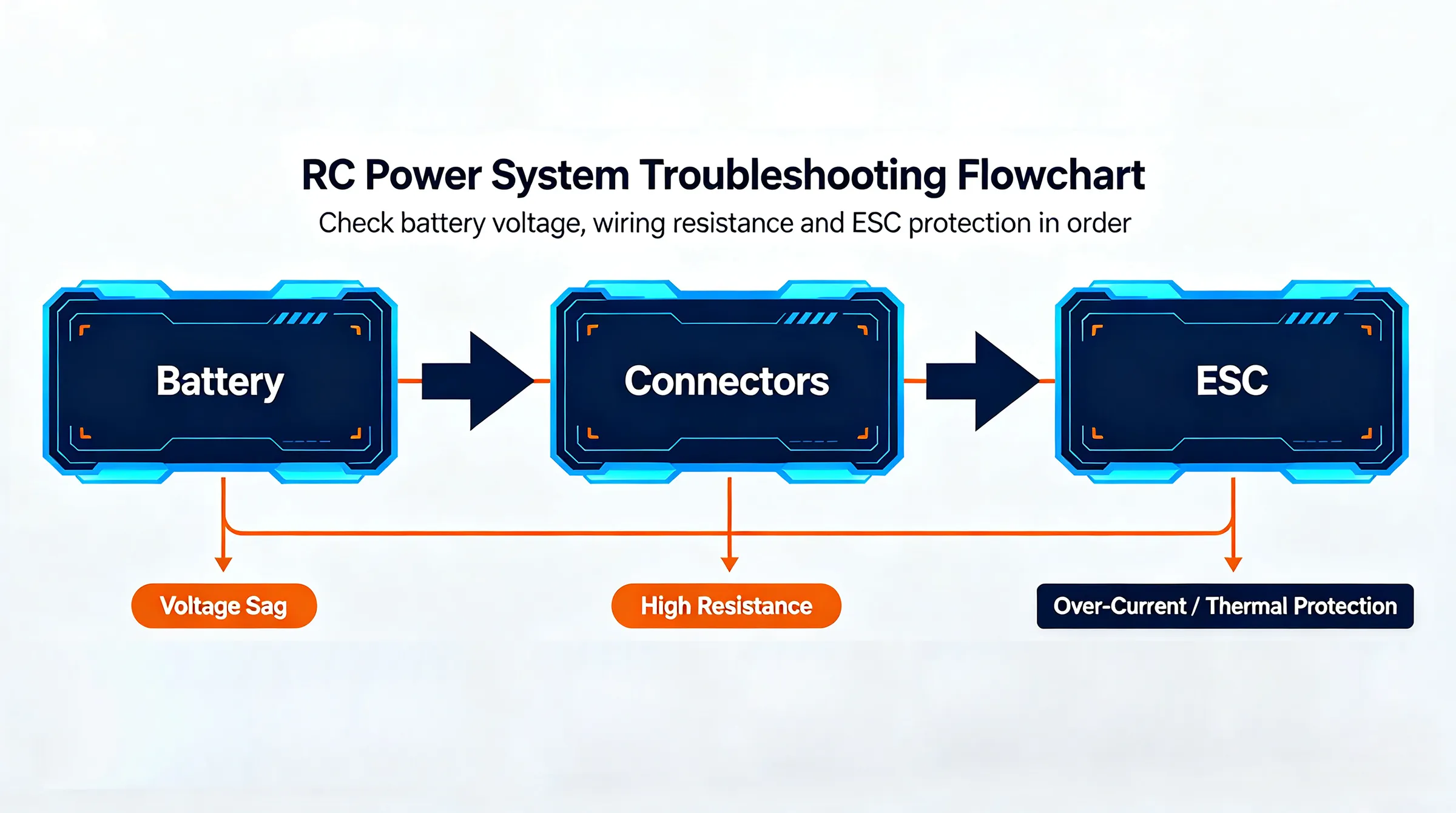
The three primary suspects are:
1. Battery voltage sag or low-voltage cutoff
2. High-resistance connectors or wiring
3. ESC over-current or thermal protection
Diagnosing them in the correct sequence saves time and prevents unnecessary part replacement.
A healthy LiPo pack maintains relatively stable voltage under load. An aging or undersized pack will sag dramatically when high current is demanded. The ESC sees the voltage drop and triggers its low-voltage cutoff (LVC) to protect the cells. Once the load is removed, voltage rebounds, so a resting voltage check may look normal.
How to test: Charge the pack fully. Measure resting voltage, then apply full throttle while monitoring voltage with a telemetry system or by observing ESC behavior. A sharp drop that recovers after the throttle is released points to sag.
Common solutions:
Use a higher C-rating or higher-capacity pack suited to the motor and ESC
Replace packs that have high internal resistance or a weak cell
Ensure the pack is fully balanced and not stored at low voltage for long periods
RC car lithium ion battery packs can exhibit this behavior as they age. NiMH packs sag more gradually but can still cause similar symptoms when worn.
If the ESC LVC is set too conservatively for the cell count, it will cut power earlier than necessary. Always confirm the ESC is programmed for the correct number of cells (2S or 3S) and that the cutoff voltage matches the chemistry.
Running a high-KV brushless motor with tall gearing on a low-C or small-capacity pack is a frequent cause of cut-outs. The pack simply cannot supply the current the system demands.
Connectors and wires are often overlooked, yet they are one of the most common sources of intermittent power loss under load.
Loose, oxidized, or poorly soldered connectors create resistance. Under light load the voltage drop is small; under full throttle the drop becomes large enough to trigger LVC or cause the ESC to brown out. Heat is a tell-tale sign—any connector that becomes warm after a short run is restricting current.
Inspection checklist:
Battery plug (Deans, XT60, EC5, etc.) for looseness or discoloration
Bullet connectors between ESC and motor
Solder joints on the ESC power wires
Any adapters or extensions in the power path
Clean, reseat, or replace any suspect connection. High-quality silicone wire of adequate gauge is essential for systems using a 60a brushless ESC, 80a brushless ESC, or higher.
Wires that have been pinched under the chassis, rubbed against the motor, or repeatedly flexed can develop internal breaks. These often pass a continuity test at rest but fail under vibration and high current.
The electronic speed controller is the brain of the power system. Modern brushless ESCs include multiple protection features that can cause a cut-out under full throttle.
When the current draw exceeds the ESC’s continuous or peak rating, the unit shuts down to protect itself. This is especially common when:
Gearing is too tall (large pinion / small spur)
The motor is larger or higher KV than the ESC was designed for
The vehicle is heavy or has high-grip tires that increase load
A 60 amp brushless ESC is typically suitable for many 1/10 brushless setups, while 1/8 scale platforms often require an 80a or 120a brushless ESC. Matching the ESC rating to the motor and intended use is critical.
If the ESC overheats, it will reduce power or cut out completely. Causes include insufficient airflow, dusty conditions, sustained full-throttle running, or an undersized ESC. After the unit cools, power usually returns—classic thermal protection behavior.
Diagnosis tip: Feel the ESC heatsink after a run. If it is too hot to touch comfortably, thermal limiting is likely occurring.
The Battery Eliminator Circuit (BEC) inside the ESC powers the receiver and servos. A high-torque servo, multiple servos, or LED light kits can overload a weak BEC, causing the receiver to brown out under load. Steering may still work while throttle cuts, or the entire system may reset.
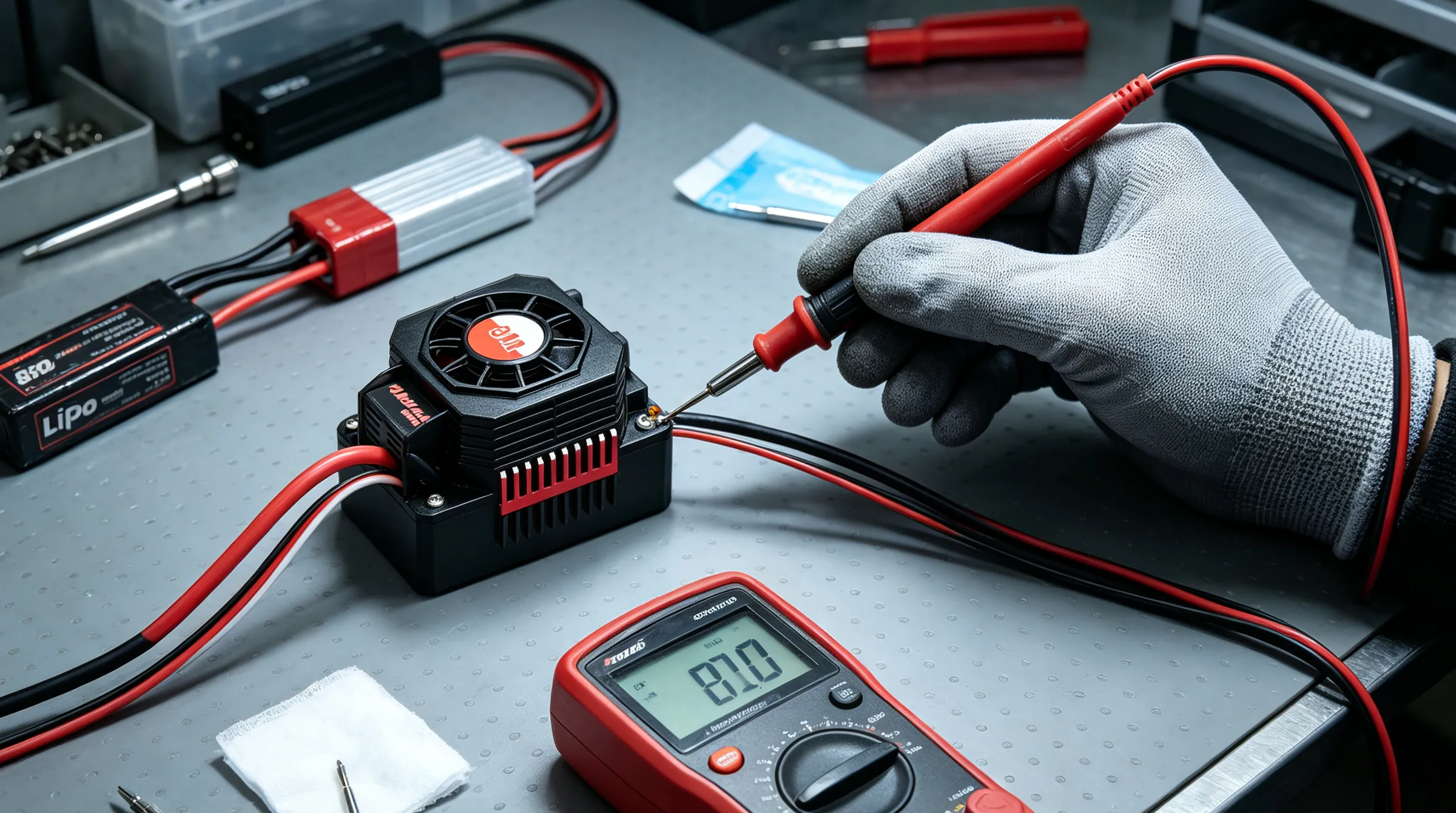
Follow this sequence for efficient troubleshooting:
1. Confirm the battery is fully charged and balanced.
2. Swap in a known-good pack of the correct voltage and adequate C-rating.
3. Inspect and reseat every high-current connector.
4. Check for excessive heat at connectors, motor, and ESC after a short full-throttle run.
5. Verify ESC programming (cell count, LVC, timing).
6. Reduce gearing (smaller pinion) and retest.
7. If the problem persists, test with a different ESC of appropriate rating.
This method isolates the fault without unnecessary part replacement.
Match battery C-rating and capacity to the motor and driving style.
Use high-quality connectors and keep them clean.
Choose an ESC with adequate continuous and peak current headroom (for example, a brushless ESC 80a or ESC 120a brushless for higher-power 1/8 setups).
Maintain proper gearing so the motor and ESC stay within temperature limits.
Allow components to cool between hard runs.
Regularly inspect wiring for damage or chafing.
Manufacturers such as VRX Racing offer a range of matched components—including 60a brushless ESC, higher-amp brushless units, quality RC car Lipo battery packs, and compatible chargers—that help reduce these issues when systems are properly assembled.
When an RC car cuts out under full throttle, the power system is telling you that demand has exceeded supply at some point in the chain. In the majority of cases the root cause is battery sag, a high-resistance connection, or an ESC protecting itself from over-current or overheating.
By testing the battery under load, inspecting every connector, and confirming that the ESC rating and programming match the rest of the system, most drivers can restore reliable full-throttle performance. A methodical approach not only solves the immediate problem but also prevents more serious damage to the motor, ESC, or battery.
Address the weak link, and the car will deliver consistent power exactly when you need it most.