An RC car may look small, but off-road driving can place serious demands on its mechanical structure. A jump followed by a hard landing can transfer a large amount of force through the tires, suspension, chassis, drivetrain, and differentials in a fraction of a second. Repeated impacts can be even more demanding than maximum speed.
This is why modern RC cars are not simply designed around powerful motors or engines. Their performance depends on how effectively the entire vehicle absorbs, distributes, and manages impact forces.
From a 1/8 nitro RC car to an electric truggy or a compact 1/10 nitro platform, different RC categories have developed specific engineering solutions for rough terrain. The result is a fascinating combination of suspension design, chassis construction, drivetrain durability, and tire technology.
On a smooth surface, an RC car can use much of its available power without encountering major mechanical shocks. Off-road driving is different.
A vehicle can leave the ground, land on one wheel, hit a rut, or encounter an obstacle while accelerating. Each event creates a sudden load that travels through the suspension and chassis. If the vehicle cannot distribute that force effectively, components such as suspension arms, driveshafts, gears, or shock absorbers can become stressed.
For this reason, off-road RC engineering is largely about controlled movement. The suspension must absorb energy, the tires must maintain contact with the ground, and the chassis must remain rigid enough to protect the drivetrain.
This is one reason why large off-road platforms often look substantially more robust than simple on-road models.
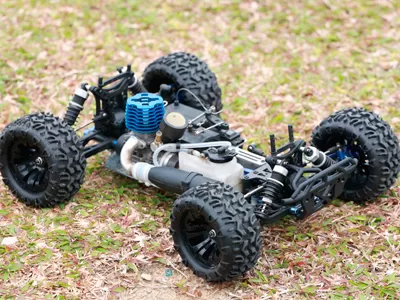
The 1/8 scale nitro RC car is a good example of an RC platform developed around demanding terrain.
Its larger physical dimensions provide room for substantial suspension components, larger tires, four-wheel-drive hardware, and a powerful internal-combustion engine. VRX Racing's 1/8 nitro models use SH 21 or SH 28 engines, 6061/T6 anodized aluminum chassis construction, four-wheel drive, and approximately 35–42 mm of ground clearance.
The structure is important because a powerful engine is only useful if the drivetrain and chassis can handle the resulting loads.
A 1/8 scale nitro RC buggy such as the VRX-2 therefore combines power with long-travel suspension and substantial ground clearance. This allows the vehicle to remain controllable when driving over jumps, rough dirt, and uneven surfaces.
Suspension is one of the first systems to experience impact.
When an RC car lands after a jump, the tires contact the surface before the chassis. Oil-filled shocks control how quickly the suspension compresses and rebounds. Springs support the vehicle's weight, while shock oil controls the movement of the suspension.
Modern 1/8 electric platforms from VRX Racing use adjustable, large-bore oil-filled aluminum shocks. Combined with independent suspension, these systems are designed to provide damping during jumps and help maintain stability on uneven terrain.
The objective is not simply to make the suspension soft. Excessive compression can make the chassis bottom out, while insufficient damping can cause bouncing after landing.
Good suspension design therefore represents a compromise between impact absorption, body control, traction, and steering response.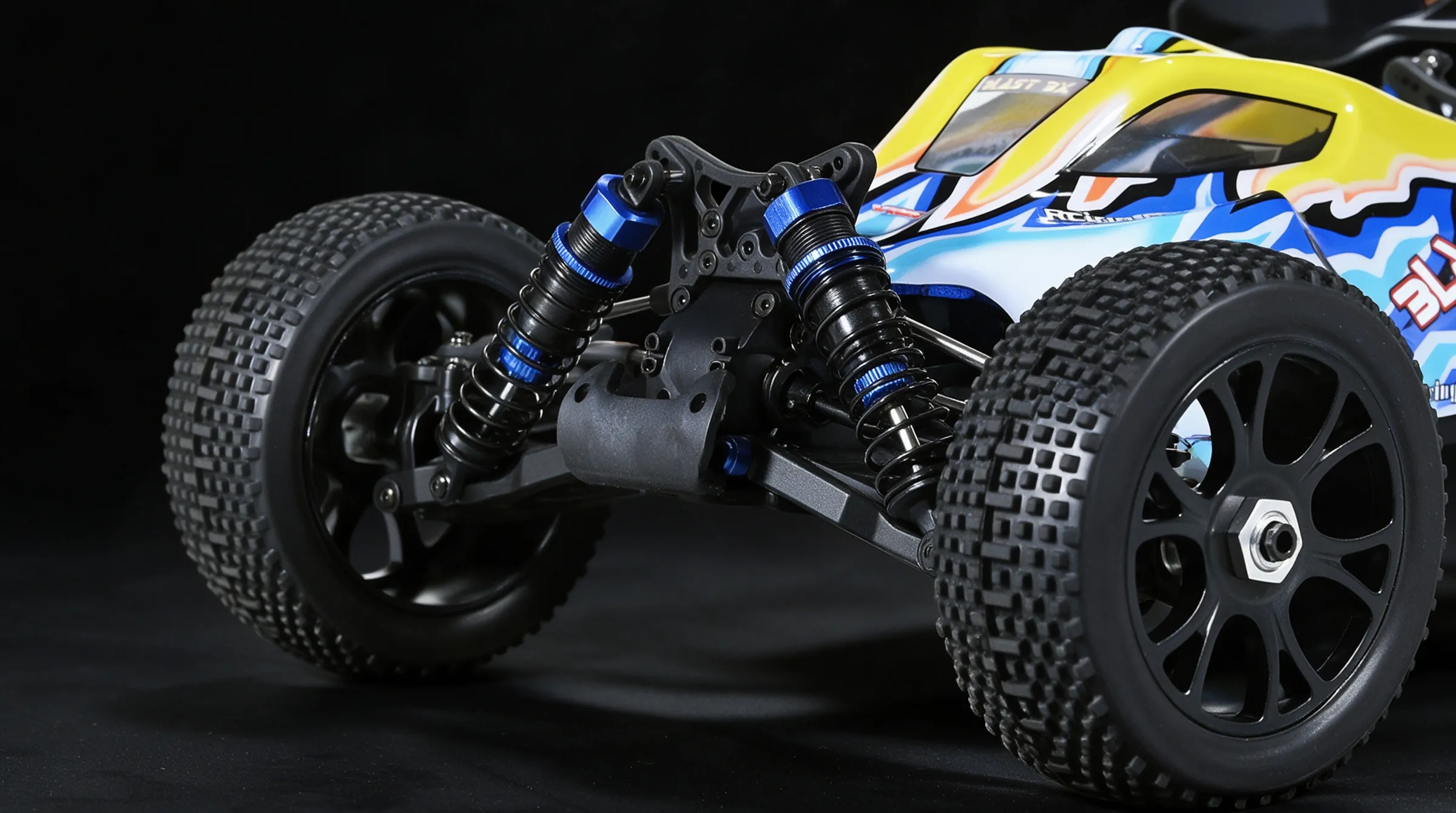
An electric truggy approaches rough terrain from a slightly different direction.
Truggies combine elements of buggy handling with a wider stance, longer wheelbase, and larger tires. This gives them additional stability while retaining relatively responsive steering.
VRX Racing's electric truggy lineup includes 1/8 COBRA and VRX-1E models as well as the 1/10 MEGREZ. The 1/8 COBRA uses a 4WD chassis, heavy-duty aluminum components, large oil-filled shocks, and large tires designed for rough terrain and jumps.
The result is a vehicle that can absorb impacts while maintaining stability at speed.
An e truggy therefore does not simply represent an electric version of a conventional truck. Its chassis proportions are deliberately suited to a combination of agility and durability.
Electric vehicles have their own approach to rough-terrain engineering.
A modern electric RC vehicle can deliver strong torque immediately, which means the drivetrain may experience substantial loads during rapid acceleration. Manufacturers therefore need to consider gears, differentials, driveshafts, tires, and chassis reinforcement as part of the complete system.
VRX Racing's 1/8 electric range uses 4WD systems, robust differentials, steel gears, rigid chassis structures, and adjustable oil-filled shocks. Depending on the model, brushless systems use motors such as 3660 2000KV or 3674 2440KV with 60A–120A ESCs and 2S–4S LiPo compatibility.
This combination allows the vehicle to produce strong acceleration while maintaining the mechanical strength required for demanding off-road conditions.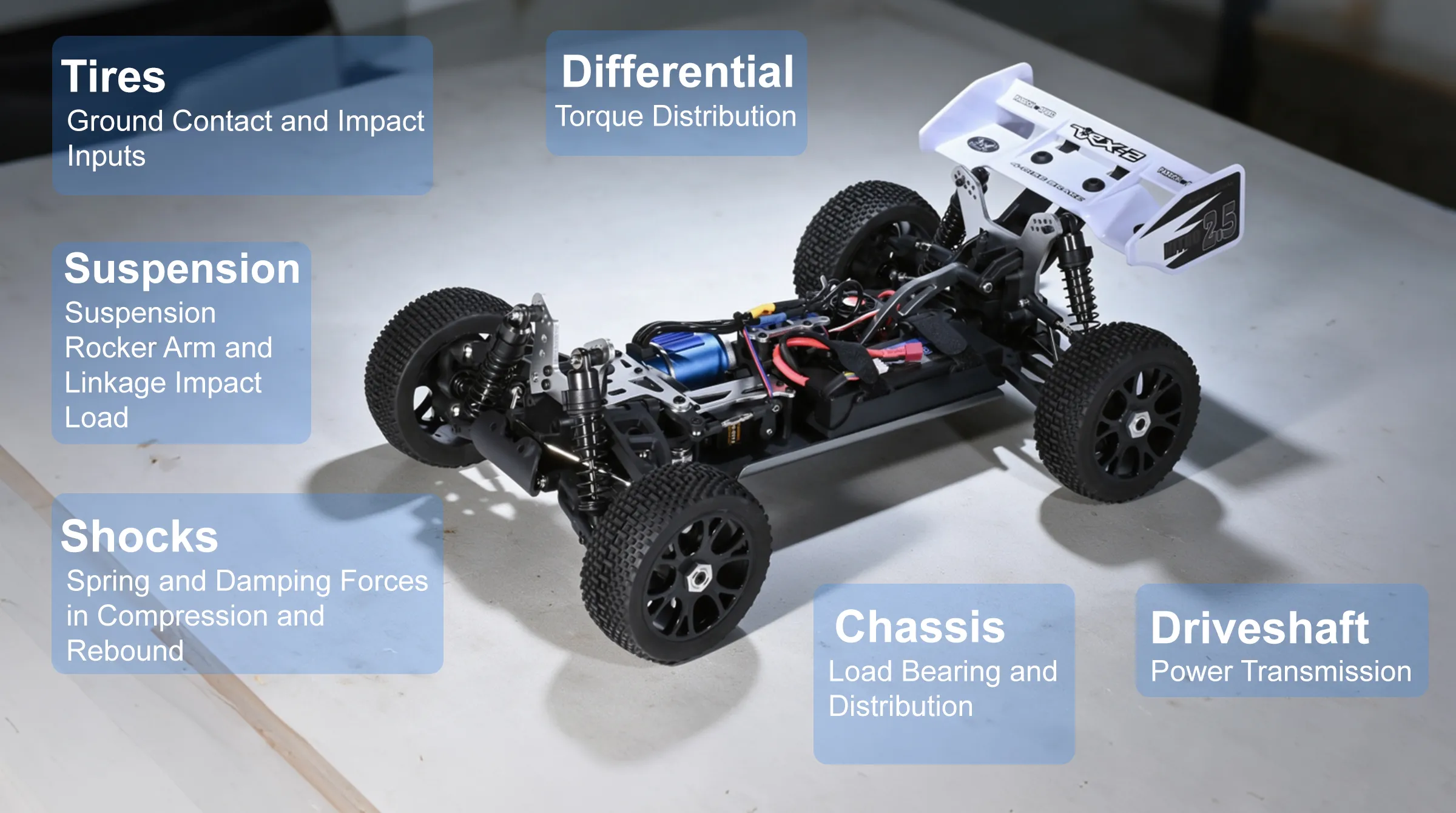
An electric RC monster truck faces a different type of impact challenge.
Large tires and high ground clearance allow monster trucks to drive over obstacles that would stop lower vehicles. However, larger tires also increase the mechanical leverage applied to suspension and drivetrain components.
VRX Racing's electric monster truck lineup uses oversized tires, elevated ground clearance, reinforced chassis structures, independent suspension, and 4WD drivetrains. The range includes both brushed and brushless configurations across 1/10 and smaller platforms.
The design priority is therefore not simply racing-line precision. It is the ability to survive aggressive driving, obstacles, jumps, and repeated impacts.
This explains why monster trucks often have noticeably larger tires and more open suspension travel than traditional racing buggies.
A 1/10 RC nitro platform has less physical mass and a smaller chassis than a 1/8 vehicle, but it still needs to manage the forces generated by off-road driving.
VRX Racing's 1/10 nitro range includes SPIRIT N1 and N2 buggies, THOR truggy models, and NITRO short course trucks. The platform uses SH 18 engines and 6061/T6 aluminum chassis construction, with models capable of reaching speeds of approximately 60 km/h.
Because the chassis is smaller, component packaging becomes particularly important. Suspension, engine, fuel tank, drivetrain, and radio equipment must all fit into a compact space without compromising balance.
A 1/10 scale nitro RC model can therefore provide a compact alternative to larger off-road platforms while retaining many of the mechanical characteristics associated with nitro driving.
Jump landings are only one form of stress. Close racing creates another.
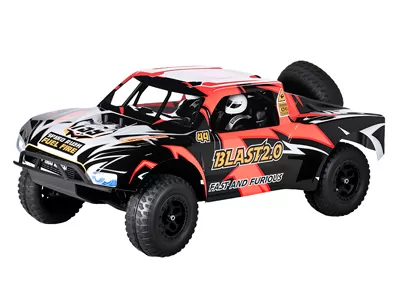
An electric short course truck is designed with a relatively wide stance and enclosed wheel arches. These characteristics help protect the wheels and suspension when several vehicles are racing in close proximity.
VRX Racing's short course lineup includes 1/10 BLAST 2.0 models in brushed and brushless configurations as well as a 1/8 platform. The vehicles use 4WD systems and independent suspension for dirt, clay, gravel, and asphalt surfaces.
Compared with an open-wheel buggy, the body structure provides additional protection around the wheels. This makes the short course format particularly suitable for racing environments where contact and aggressive driving are common.
Tires are another important part of impact management.
A larger tire can provide greater ground clearance and help absorb some of the initial shock when crossing uneven terrain. However, it also increases rotational mass and can place greater loads on the drivetrain.
This is one reason vehicle categories use different tire sizes.
A 1/8 nitro RC truck can use substantially larger tires than a compact 1/10 buggy because the larger chassis and drivetrain are designed to handle them. A truggy similarly uses large tires to combine stability, traction, and obstacle clearance.
Tire design therefore affects much more than grip. It influences suspension movement, drivetrain loading, vehicle balance, and how the chassis reacts to obstacles.
The most interesting aspect of modern RC engineering is that durability cannot be added through one component.
A stronger chassis cannot compensate for poorly controlled suspension. Larger shocks cannot solve weak drivetrain components. Powerful tires can actually increase stress on gears and driveshafts.
Instead, manufacturers need to design the vehicle as a complete mechanical system.
VRX Racing's current range demonstrates this approach across different categories. Its 1/8 nitro cars, electric truggies, 1/10 nitro models, electric monster trucks, and short course trucks use different combinations of chassis geometry, suspension travel, tire dimensions, drivetrain layouts, and power systems according to their intended terrain.
Off-road RC performance is not measured only by how fast a vehicle can accelerate.
A genuinely capable vehicle must remain predictable after a hard landing, maintain traction over rough ground, protect its drivetrain from sudden loads, and recover quickly from suspension movement.
That is why the modern 1/8 nitro RC car, electric truggy, electric monster truck, and 1/10 scale nitro RC platform each use different engineering solutions.
The goal is not to eliminate impact. Off-road driving makes that impossible. Instead, successful RC design manages impact so that energy is absorbed by the tires, suspension, and chassis without compromising control.
For VRX Racing, this philosophy appears across its modern product range: build the vehicle around the environment it will face, then balance power, suspension, structure, and drivetrain durability accordingly.
In the end, the ability to take a hard landing may tell us more about an RC car's engineering than its top-speed specification ever could.