Walk into the RC hobby market and one of the first things you will notice is the variety of vehicle sizes. You may find a compact 1/18 model beside a much larger 1/8 buggy, while 1/10 remains one of the most common choices for trucks, rally cars, and general-purpose models.
This raises an interesting question: why are RC cars made in different scales in the first place?
The answer is not simply that some drivers prefer large cars and others prefer small ones. Scale affects almost every part of an RC vehicle, including chassis dimensions, motor or engine selection, battery capacity, suspension travel, tire size, weight, stability, transport requirements, and even the type of terrain where the model performs best.
For manufacturers such as VRX Racing, offering several scales makes it possible to design RC vehicles around different performance targets rather than forcing every model into the same physical platform.
An RC car scale chart normally compares a model with the approximate dimensions of a corresponding full-size vehicle. For example, a 1/10 model is theoretically about one-tenth the size of the original vehicle, while a 1/8 model is approximately one-eighth.
However, scale is not a guarantee of exact dimensions. Different vehicle types have different proportions, wheelbases, body shapes, and chassis layouts. A 1/10 truck and a 1/10 rally car can therefore have noticeably different physical dimensions.
Scale should be viewed as an engineering reference rather than a simple measurement of length.
This distinction becomes important when comparing a 1/8 electric RC car with a 1/10 model. The larger scale creates more available physical space, but designers must also account for the additional weight and the power required to move it.
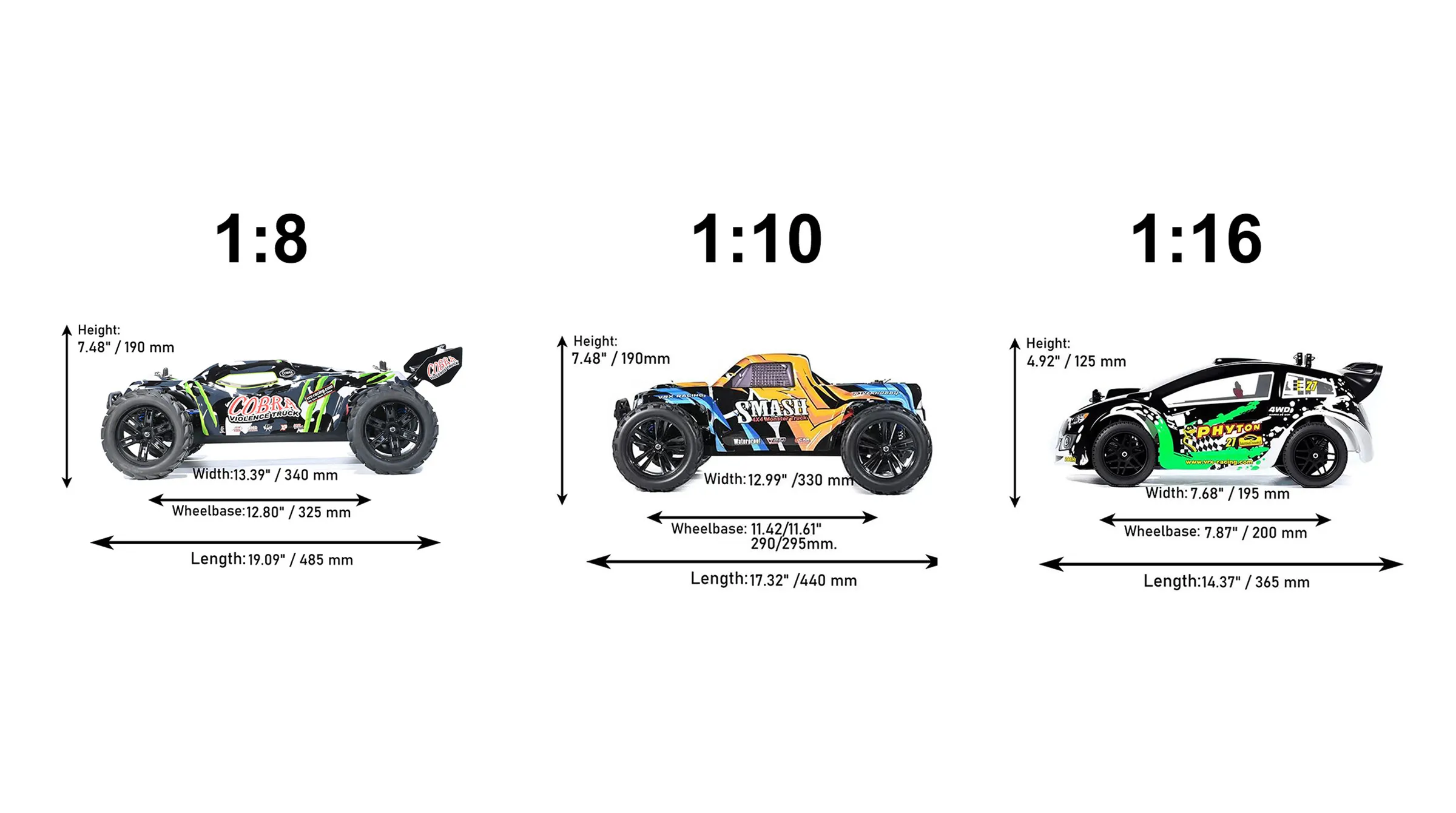
A larger RC car can accommodate bigger components, but bigger does not automatically mean better.
As a model grows, its weight generally increases. The motor or engine must produce enough torque to accelerate the vehicle, while the suspension, drivetrain, tires, and chassis must withstand greater loads.
A 1/8 platform therefore requires a different engineering balance from a 1/10 platform.
VRX Racing's current electric lineup illustrates this approach. Its 1/8 models use 4WD platforms, larger brushless motors, high-capacity ESCs, larger tires, and heavy-duty suspension systems. Some configurations use 3660 or 3674 brushless motors and support 2S–4S LiPo battery setups.
By contrast, the company's 1/10 electric models use smaller 3650-class brushless motors or 540/550 brushed motors, creating a lighter platform with a different balance between speed, weight, and maneuverability.
The result is not simply two sizes of the same car. They are different engineering solutions.
One of the biggest factors determining RC size is where the vehicle is expected to operate.
A large 1/8 scale electric RC truck is well suited to open outdoor environments where there is enough space to use its speed, ground clearance, and suspension travel. Larger tires can help the vehicle cross loose dirt, grass, gravel, and uneven terrain.
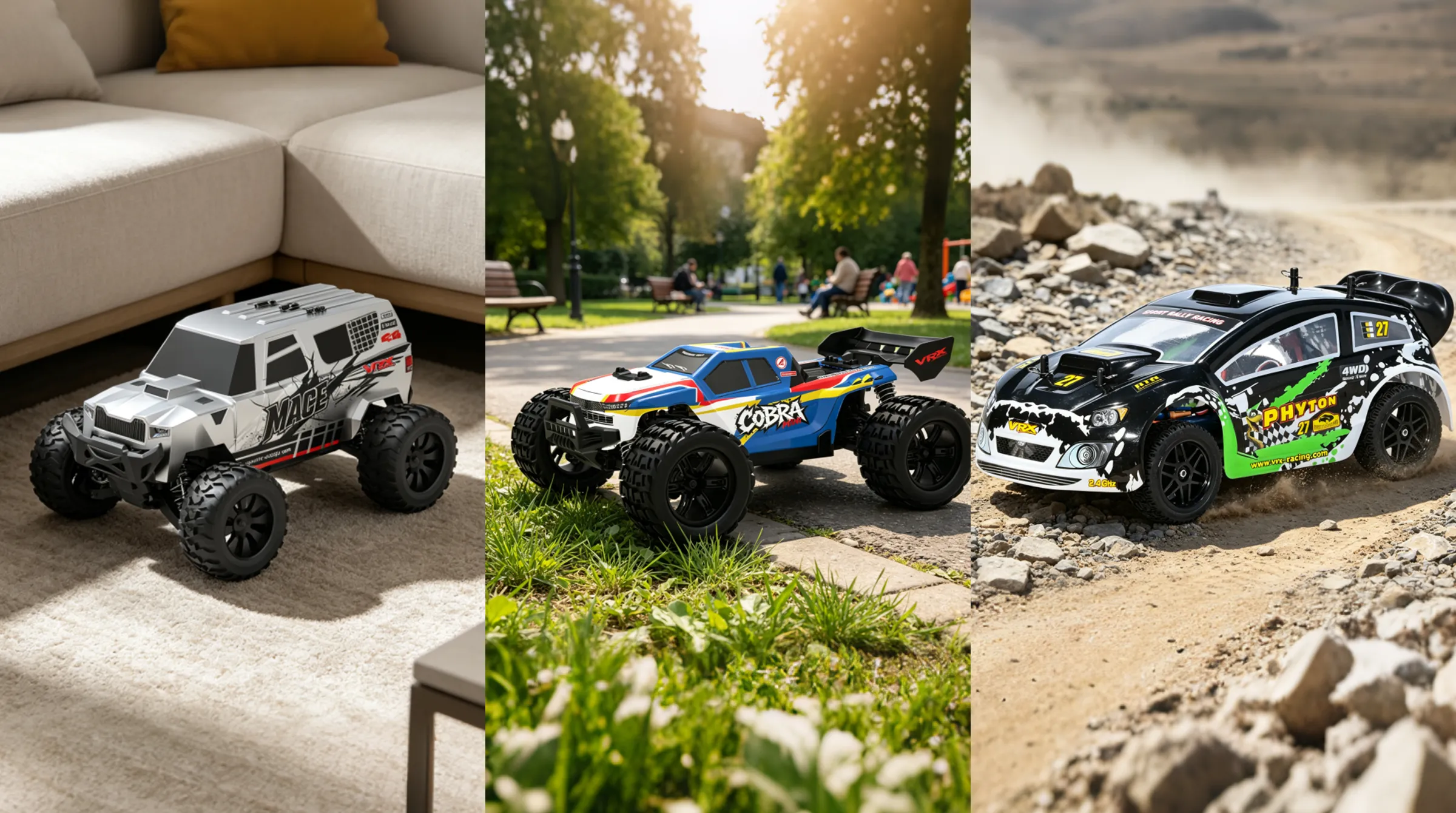
A smaller 1/10 platform is more flexible when space is limited. It can work well in local tracks, driveways, parks, and mixed surfaces where a larger vehicle may be unnecessarily difficult to transport or maneuver.
This is why scale selection should begin with the question:
Where will the RC car actually be driven?
The best size is determined by the environment, not simply the largest available specification.
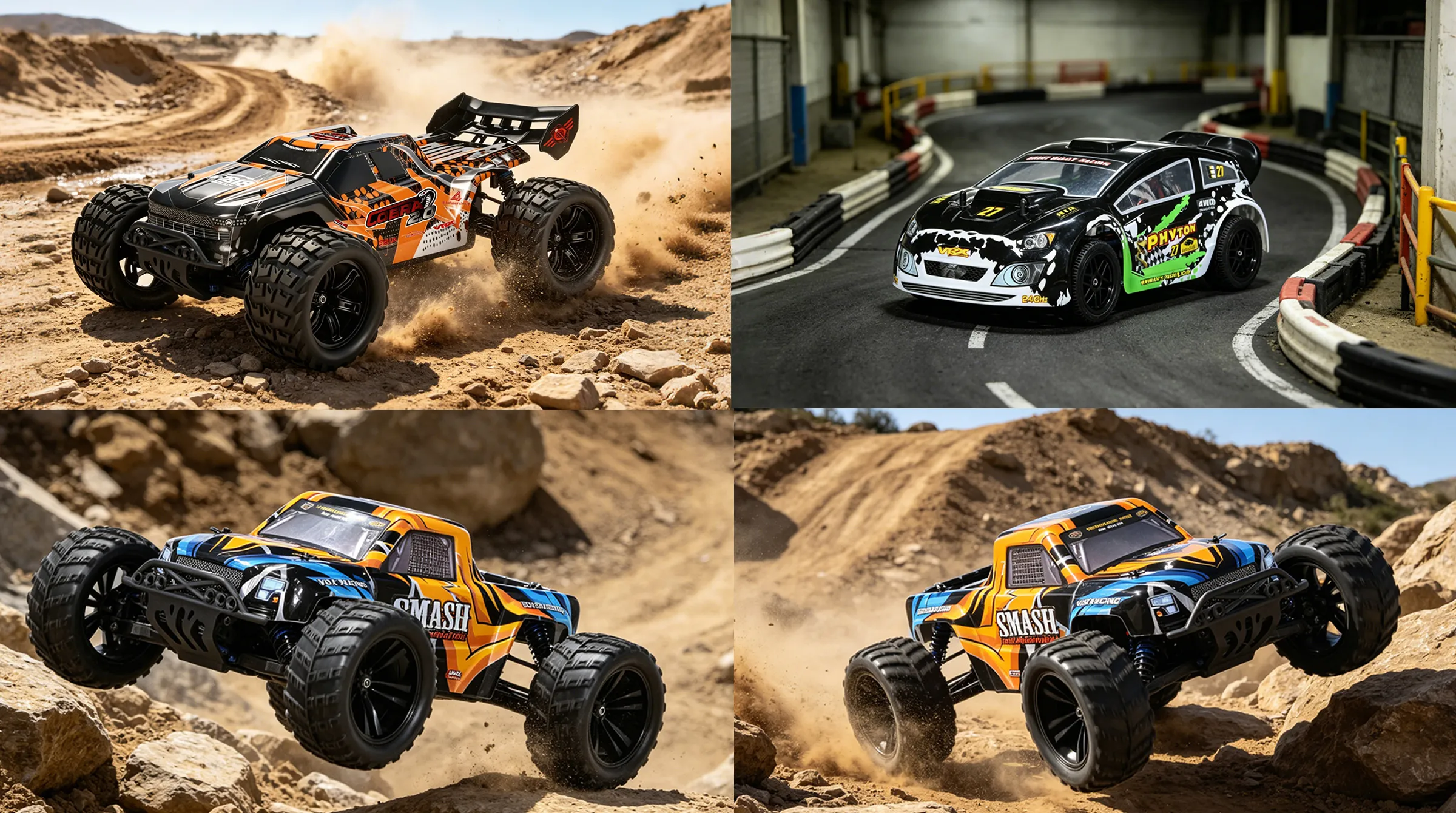
The relationship between size and power becomes even clearer when comparing electric and nitro models.
A 1/8 scale electric RC cars platform needs sufficient battery capacity and motor output to move its greater mass. A larger chassis also gives designers room for batteries, ESCs, motors, cooling systems, and stronger drivetrain components.
For a 1/10 platform, component sizes can be reduced because the vehicle generally weighs less.
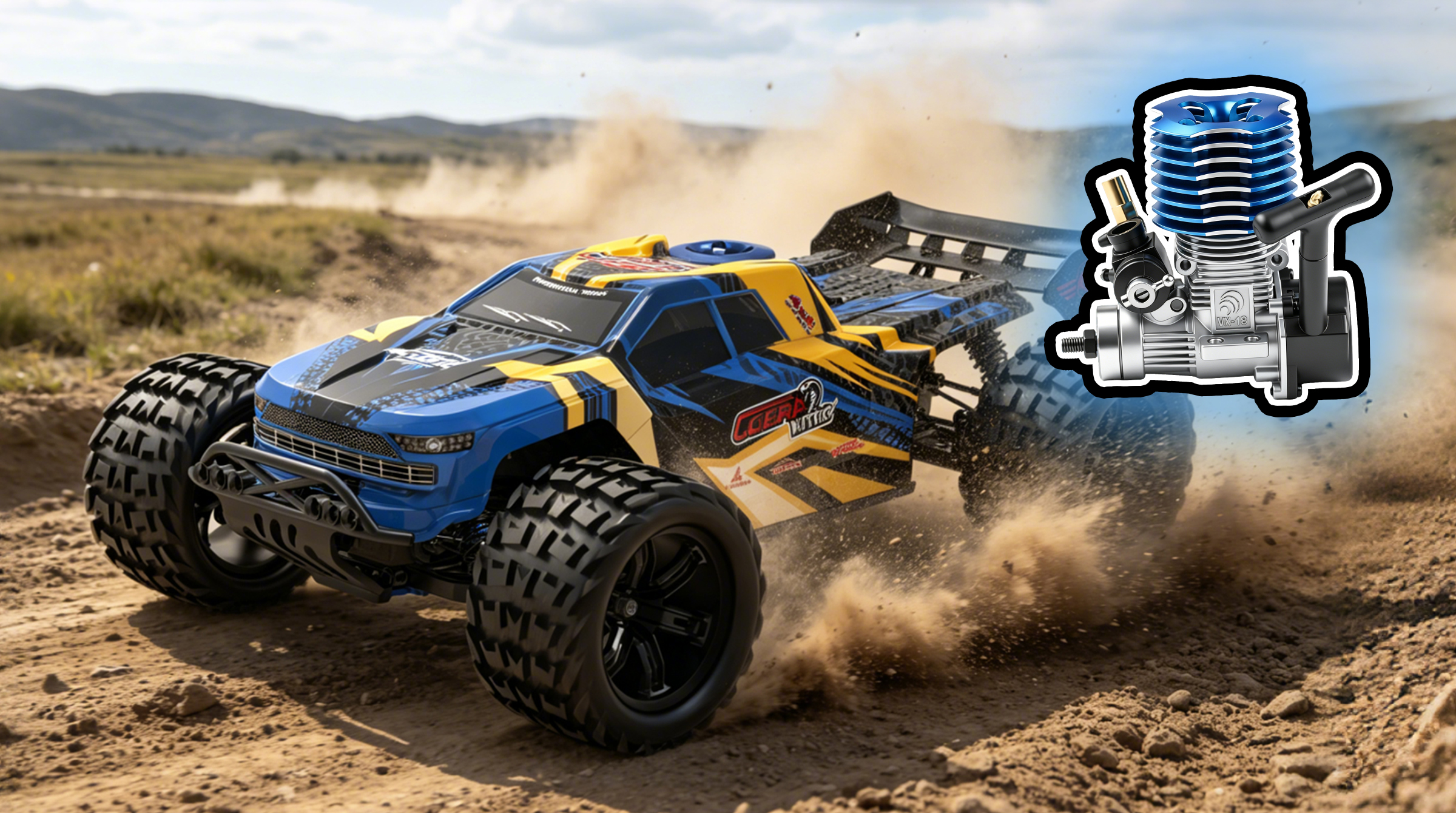
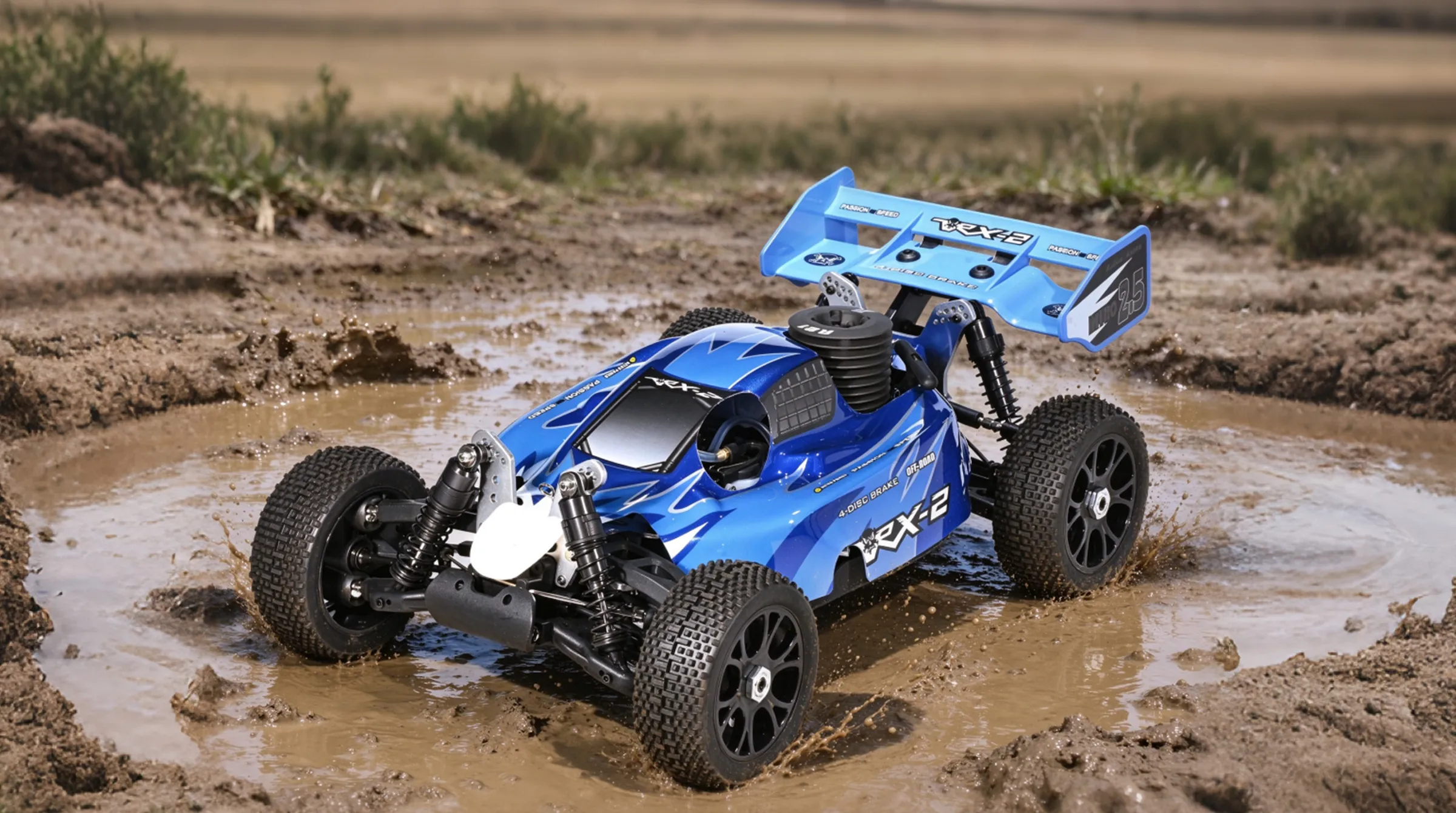
Nitro vehicles follow a different logic. A 1/8 nitro car requires physical space for the engine, fuel tank, exhaust system, clutch, drivetrain, and associated components. Engine displacement also becomes part of the design equation.
VRX Racing lists .18, .21, and .28 nitro engines, corresponding to approximately 2.74 cc, 3.48 cc, and 4.57 cc respectively. Matching engine capacity to chassis size and intended application is essential for achieving a useful balance between power and control.
That is why a 1/8 scale nitro buggy and a smaller nitro model cannot simply use identical components.
The popularity of 1/10 comes partly from its versatility.
A 1/10 electric RC platform has enough physical space for practical electronics and suspension components without becoming excessively large or heavy. This makes the scale suitable for a broad range of vehicle types.
VRX Racing's 1/10 range includes off-road trucks, buggies, truggies, rally cars, short-course trucks, and other configurations. Both brushed and brushless power systems are available, allowing the same general scale to serve different performance levels.
The scale can therefore support everything from a straightforward recreational model to a fast brushless vehicle.
A 1/10 RC truck brushless model, for example, can offer strong acceleration without requiring the physical size of a 1/8 platform. This makes 1/10 particularly attractive to drivers who want a balance between performance and everyday practicality.
The engineering logic changes when moving toward 1/8.
A larger chassis allows designers to increase suspension travel, tire diameter, drivetrain strength, and power-system capacity. This is especially valuable for high-speed off-road vehicles.
VRX Racing's 1/8 electric range includes buggies, truggies, and short-course trucks, with brushless configurations capable of high-speed driving. The platform uses features such as aluminum chassis construction, 4WD drivetrains, adjustable oil-filled shocks, and larger-bore suspension components.
The same principle applies to combustion-powered models. A 1/8 scale nitro RC truck can use the additional chassis space for a larger engine and more substantial mechanical components.
However, this also means more weight, higher running costs, and greater physical requirements for transportation and storage.
Scale cannot be separated from body style.
A 1/8 nitro rally car needs a different balance from a dedicated off-road buggy. A drift car prioritizes steering response and controlled weight transfer, while a short-course truck needs suspension durability and impact resistance.
Even within the same scale, these priorities can result in completely different chassis designs.
For example, electric RC cars designed for drifting can use lower ride heights and road-oriented tires, while an off-road truck needs significantly more clearance and suspension movement. VRX Racing separates its product categories into drift cars, rally models, buggies, truggies, monster trucks, short-course trucks, and crawlers for precisely this reason.
Scale provides the foundation, but vehicle purpose determines how that space is used.
Factor | 1/8 Scale | 1/10 Scale |
Physical size | Larger | More compact |
Typical use | High-performance outdoor driving | Versatile recreational and performance use |
Power capacity | Higher potential | Moderate to high |
Suspension | Longer travel potential | More compact setup |
Terrain | Rough and open terrain | Mixed terrain and smaller tracks |
Transport | Less convenient | Easier |
Component space | More available | More limited |
Typical models | Buggy, truggy, truck | Truck, buggy, rally, drift, truggy |
The comparison shows why neither scale is universally “better.” They are optimized around different constraints.
The next time you see a 1/8 scale electric RC truck beside a 1/10 model, think beyond their physical dimensions.
Their sizes are the result of a chain of engineering decisions: the target terrain determines ground clearance, the vehicle type determines chassis geometry, the power system determines component requirements, the expected speed influences drivetrain strength, and the intended user determines how much portability matters.
That is also why the RC industry needs multiple scales rather than one universal size.
VRX Racing demonstrates this philosophy through a product range covering 1/8, 1/10, 1/16, 1/18, and 1/24 platforms, with different combinations of electric, nitro, brushed, and brushless systems.
Ultimately, choosing between a 1/8 scale electric RC cars model, a 1/10 electric truck, or another platform is not really a question of “which size is best?”
It is a question of which engineering package best matches the way you want to drive.